
9 June 2026
AI became a commodity the day everyone started using it the same way
TL;DR: AI stopped being a competitive advantage when organizations began deploying identical models against unchanged operations. The technology commoditized in under three years through infrastructure cost collapse (99% reduction), uniform implementation, and structural homogenization. Competitive differentiation moved from model access to architectural integration. Same model, same prompts, same broken system underneath = zero advantage. Infrastructure costs fell 99% in three years. What cos
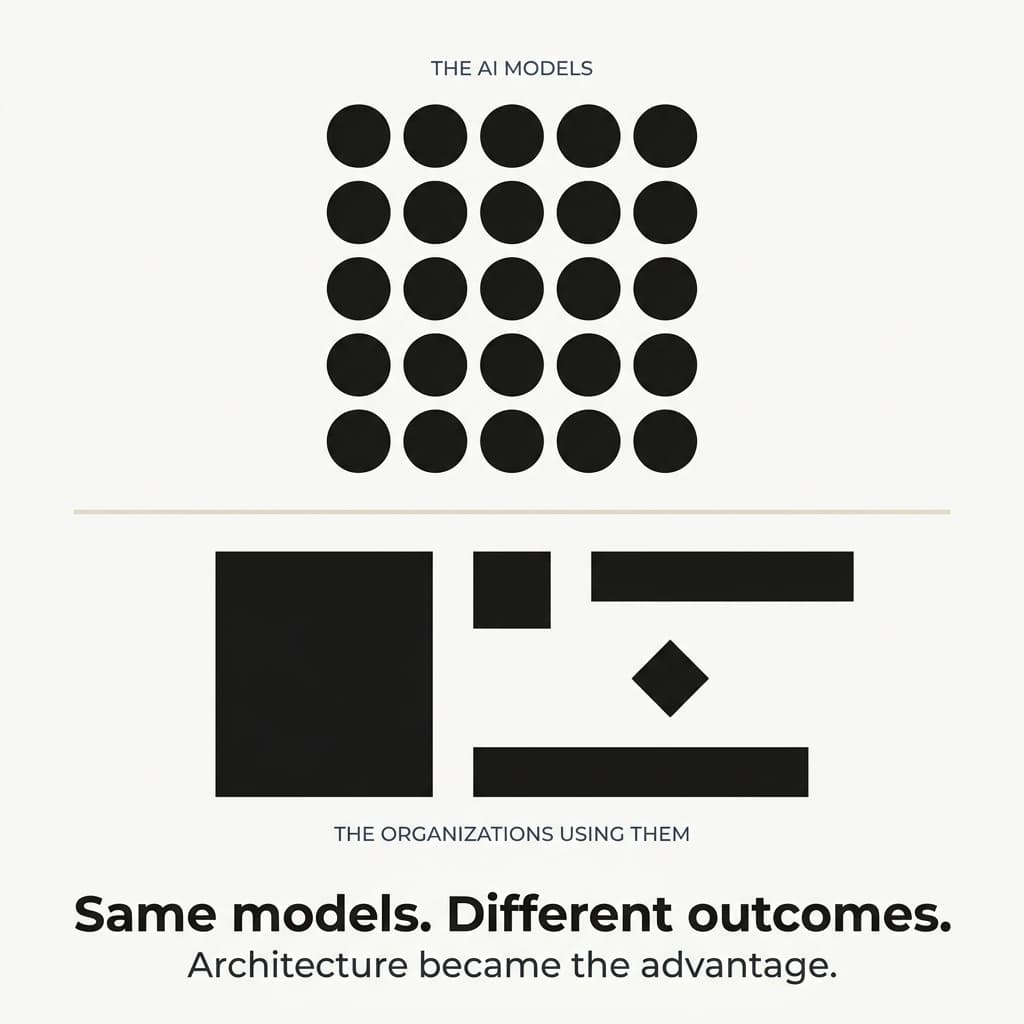
TL;DR: AI stopped being a competitive advantage when organizations began deploying identical models against unchanged operations. The technology commoditized in under three years through infrastructure cost collapse (99% reduction), uniform implementation, and structural homogenization. Competitive differentiation moved from model access to architectural integration.
Same model, same prompts, same broken system underneath = zero advantage.
Infrastructure costs fell 99% in three years. What cost $20 per million tokens in 2022 costs $0.05 in 2026.
Uniform AI usage produces identical outputs. Trading algorithms erased the 6% alpha advantage. AI-generated content shows 8.9% higher similarity than human work.
95% of AI pilots fail to impact P&L. The constraint is organizational design, not model capability.
Advantage shifted from access to architecture. Integration depth, data governance, and decision systems now separate winners from theater.
Most organizations deploy AI the same way. Bolt it onto the front end. Leave legacy processes intact. Preserve existing power structures.
The technology changed. The system did not.
Same models, same prompts, same unchanged operations = identical outputs across competitors.
What should have created competitive advantage became table stakes in 18 months.
Why infrastructure cost collapse proves commoditization
Running GPT-3.5-level capability cost $20 per million tokens in November 2022. By October 2024, the same capability cost $0.07. GPT-5 nano in 2026 costs $0.05.
A 99% price reduction in three years. The fastest collapse of any technology infrastructure in modern business history.
When competitors access the same foundational model via API at the same price, the model stops differentiating. Moats became utilities.
The capability you deploy today, your competitor acquires tomorrow. Same cost. Same performance. Zero advantage.
Key point: Price commoditization removes the access barrier. When everyone pays nothing, everyone has access. Differentiation dies.
How uniform usage produces homogenization
Organizations invest in AI using identical tools, from identical vendors, with identical prompts.
Research shows AI-assisted stories were 8.9 to 10.7% more similar to each other than human-written ones. The study found AI creates an increase in individual creativity at the cost of collective novelty.
AI homogenizes output. It does not differentiate.
Same model architecture, similar data, comparable problems. The outputs converge. The edge disappears. Operational parity dressed as innovation.
Trading shows the clearest proof. Overcrowded AI trading strategies erased the 6% alpha advantage quantitative models once generated. Thousands of algorithms identify identical setups simultaneously. The rush to execute eliminates price inefficiencies before anyone captures value.
Having an AI model is no longer competitive advantage in trading. It's the minimum cost of entry.
Key point: Uniform inputs produce uniform outputs. When every firm runs identical models against identical data, differentiation collapses to zero.
Why chatbots signal surface adoption
The clearest signal an organization lacks architectural AI integration: they deployed a chatbot.
Customer service chatbots are commodities. Value comes from AI invisibly woven into core business operations. Most organizations treat AI as a feature bolted onto existing processes. A sourcing tool here. An automation layer there.
The underlying system remains unchanged. Decision rights stay unclear. Data governance stays weak. Incentives stay misaligned.
A chatbot on top of a broken system is still a broken system.
95% of businesses struggle with AI adoption despite it topping corporate agendas. Most chatbot failures trace to design failures, data failures (incomplete, outdated, unstructured data), and strategy failures (lack of ownership, unclear goals).
The technology works. The system around it does not.
Key point: Surface deployment adds AI to broken processes. Architectural integration redesigns processes around AI capabilities.
What catastrophic ROI failure rates reveal
MIT researchers found 95% of AI pilots fail to generate measurable P&L impact. McKinsey reports only 6% of respondents attribute 5% or more of EBIT to AI.
BCG estimates 60% of AI transformation efforts deliver limited or no material value. Pilots succeed locally. Value rarely scales systemically.
Constellation Research survey: 42% of enterprises deployed AI without seeing ROI. Another 29% see modest gains.
AI ROI is not constrained by model capability. It's constrained by organizational readiness to absorb and scale change.
When AI ROI is framed as a tech problem, it gets delegated to IT. Organizational design problems cannot be delegated. They must be solved structurally.
Key point: 95% failure rate across multiple studies points to systemic organizational design failure, not technology failure.
Why AI amplifies friction instead of eliminating it
Unclear decision rights? AI exposes them. Weak data governance? AI magnifies it. Misaligned incentives? AI accelerates the misalignment.
Organizations experimenting with AI treat it as a new tool. Organizations succeeding with AI treat it as an architectural shift requiring redesign of how work happens.
Competitive advantage moved up the stack: architecture, integration, data governance, lifecycle management.
Not the model.
Key point: AI does not fix broken systems. AI reveals broken systems at scale.
What AI washing reveals about capability gaps
Companies announce AI-related layoffs without mature, vetted AI applications ready to fill those roles. This practice, AI washing, uses artificial intelligence as cover for cost-cutting or restructuring.
A 2026 survey of nearly 6,000 executives: 90% reported no measurable impact from AI on employment or productivity during the previous three years.
The claim is strategic. The capability is absent. The outcome is unchanged.
Key point: When the claim and the capability diverge, the market calls it washing. When 90% report zero impact, the divergence is systematic.
How code generation proves feature commoditization
GitHub reports 46% of all code is now written by AI. Development velocity increased by 55% or more for teams adopting these tools.
What took specialized teams years to build now replicates in weeks with a single founder and AI assistance.
Competitive advantage is not what you build. It's who you build for and how you reach them.
Software became the commodity. Distribution, customer relationships, operational models are where differentiation lives.
Key point: When everyone writes code at AI speed, the code stops mattering. Market access and customer intimacy become the moat.
What deep integration looks like versus surface deployment
Value unlocks when AI is invisibly woven into core business operations, not when it sits as a new tool on top of old processes.
Firms experimenting with AI treat it as a feature. Firms winning with AI treat it as substrate.
The difference shows in three places:
1. Decision architecture. AI is not consulted. It's embedded in the decision-making process. Approvals, risk assessment, resource allocation. AI operates as part of the constitutional layer, not as an advisory tool.
2. Data governance. AI does not work around bad data. The organization fixes the data architecture first. Clean pipes, clear ownership, tamper-evidence structures. AI becomes the forcing function for data discipline.
3. Lifecycle management. AI is not deployed once and forgotten. It's monitored, retrained, audited, evolved as part of operational cadence. The system treats AI like infrastructure, not like a project.
Organizations succeeding with AI redesign operations around what AI makes possible. They do not bolt AI onto legacy operations.
Key point: Surface integration adds AI. Structural integration rebuilds around AI.
The structural identity problem
The firms that lost the edge weren't unlucky. They were structurally identical to their competitors.
Same model. Same prompts. Same outputs. Same unchanged operating model underneath.
When everyone uses the same tools in the same way, the technology stops being a differentiator. It becomes table stakes. A cost of doing business. A commodity.
The competitive advantage shifted from access to architecture.
The question isn't whether you have AI. The question is whether your organization is designed to extract value from it.
Most aren't.
What separates surface adoption from structural integration
Organizations that treat AI as a project add a chatbot and call it transformation. Organizations that treat AI as architecture redesign how decisions get made, how data flows, and how work gets structured.
The tell is simple: if you removed the AI layer tomorrow, would the organization operate differently than it did two years ago?
If the answer is no, you bolted AI onto an unchanged system. If the answer is yes, you rebuilt the system around what AI makes possible.
The former creates theater. The latter creates outcomes.
AI became a commodity the moment everyone started using it the same way. The firms that win from here won't be the ones with better models. They'll be the ones with better systems.
Get these as they’re published.
Long-form on AI governance in regulated firms — what the control gap actually is, what regulators are asking for, and what the evidence has to look like. Roughly monthly. No pitches.