
4 November 2026
The 2% is the best AI governance number of 2026. The 47% is the one that will cost you.
Eighty per cent of the firms in the Bank of England's new survey have AI agents running in production. Two per cent let them act without a human in the loop in real time. That gap is not immaturity. It is a control, and the industry put it there without a rule telling it to. The Bank of England and the Financial Conduct Authority published Artificial intelligence in UK financial services — 2026 on 26 October 2026. One hundred and ninety-six firms responded: 101 larger firms and 95 smaller ones
Eighty per cent of the firms in the Bank of England's new survey have AI agents running in production. Two per cent let them act without a human in the loop in real time.
That gap is not immaturity. It is a control, and the industry put it there without a rule telling it to.
The Bank of England and the Financial Conduct Authority published Artificial intelligence in UK financial services — 2026 on 26 October 2026. One hundred and ninety-six firms responded: 101 larger firms and 95 smaller ones, with 105 completing the full survey. The respondents were UK banks, international banks and broker-dealers, insurers, non-bank lenders, investment and capital markets firms, and financial market infrastructure and payments firms. The regulators are careful to call these participating firms rather than the sector, which is the right caveat and one most coverage of the survey dropped.
Eighty-six per cent reported using AI, up from 75% in 2024. Eighty per cent reported having AI agents deployed, with a further 14% planning deployment within twelve months.
Then the survey asked the only question that matters, and the answer is the most encouraging thing I have read in a regulatory publication this year.
The ladder nobody was required to build
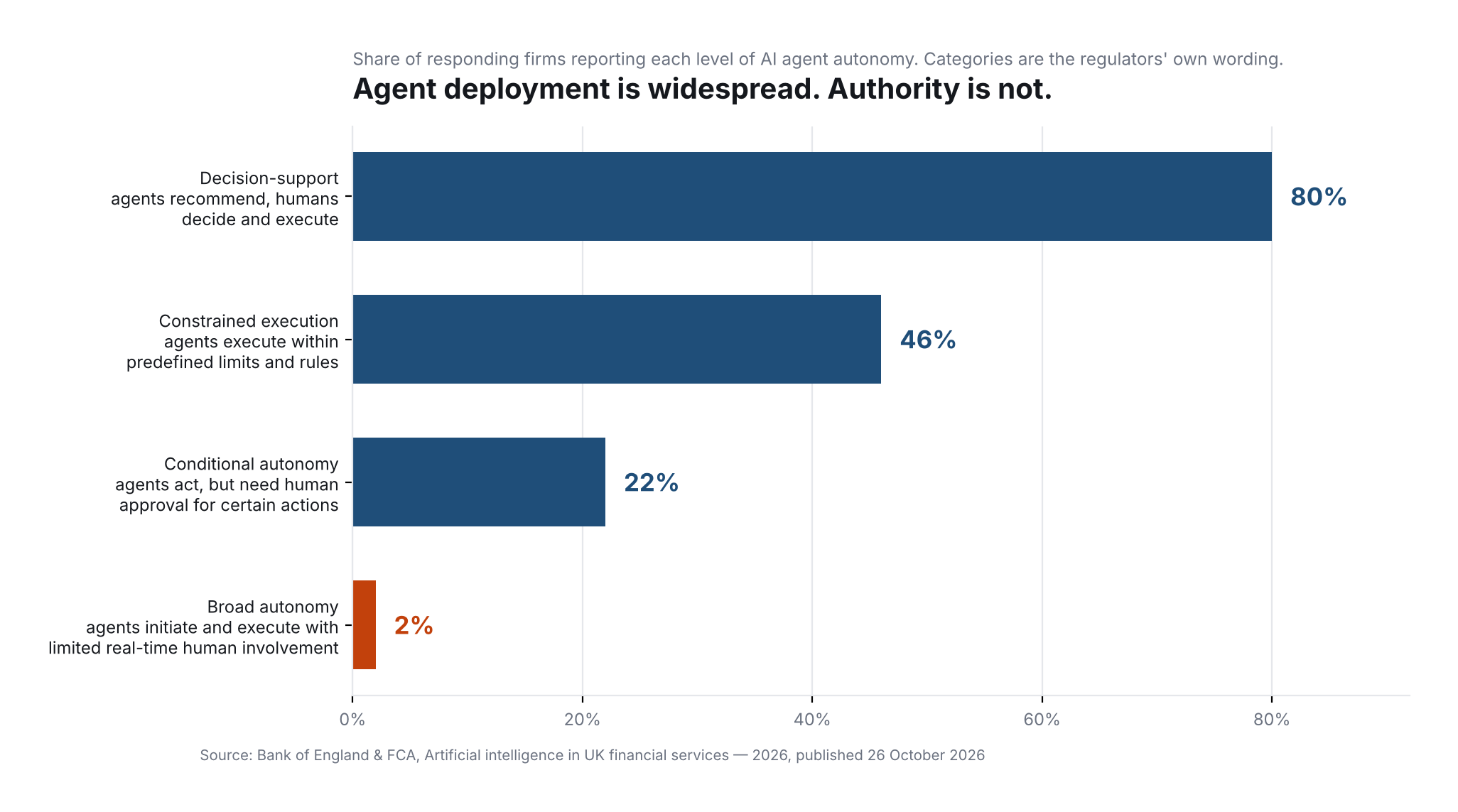
The survey sorted agent deployments by how much authority they hold. The categories are the regulators' own words.
Decision-support, where agents recommend actions and humans decide and execute: 80%.
Constrained execution, where agents execute actions within predefined limits and rules: 46%.
Conditional autonomy, where agents act independently but require human approval for certain actions: 22%.
Broad autonomy, where agents can initiate and execute actions with limited real-time human involvement: 2%.
The report's own summary of this is four words long: autonomy is limited.
Read the ladder again and notice what it is measuring. It is not measuring how good the models are. It is measuring what the firms decided the models were allowed to do. Those are different questions, and the second one is the governance question. A firm with a mediocre model on a tight leash is in better shape than a firm with an excellent model wired to an execution API.
The survey goes further and names the actions firms are not delegating. No more than 9% expected agents to approve or decline customer outcomes, execute trades, initiate payments, or change limits and controls. Four consequential actions. One in eleven firms, at most, is willing to hand any of them over.
I want to be precise about why this is good news rather than slow news. Nothing in UK regulation currently requires a firm to cap agent autonomy at decision-support. There is no threshold, no prescribed category, no return to file. The 2% is not compliance. It is a large population of firms, independently, arriving at the same conclusion about where advice stops and action starts, and then building systems that hold that line. That is what a healthy control environment looks like before the rule arrives rather than after the enforcement.
The mechanism has a name
The useful part of the survey is that it does not stop at the sentiment. It names the mechanism firms used to hold the line.
For high-materiality systems, 68% of firms used constrained autonomy or bounded action spaces to understand internally built systems, and 64% did so for third-party systems.
A bounded action space is not a policy. It is an architectural fact. It means the agent has no field it can write to, no endpoint it can call, no authority it can invoke, outside an enumerated set. The constraint lives in the integration, not in the instruction.
That distinction is the whole thing, and it is where most AI governance work goes wrong. A prompt that says "do not place trades" is a request. A service account with no trading permission is a control. The first survives until someone changes the prompt, the model updates, or a user discovers a phrasing that works. The second survives until someone changes the permission, which leaves a record and requires an approval.
The same logic explains why the oversight numbers in this survey are worth more than the usual human-in-the-loop assurance. Ninety-five per cent of firms reported human review or approval for higher-risk use cases. Human approval, pre-deployment review and vendor due diligence were each reported by more than 90% of respondents. Those are not statements that a person is nearby. Combined with the autonomy ladder, they are statements that the system cannot complete a consequential action by itself.
Where the coverage falls away
Now the part of the survey that should worry a chief risk officer, and it is not hiding. It is in the same tables.
Line the governance items up by how many firms have them and a pattern appears immediately.
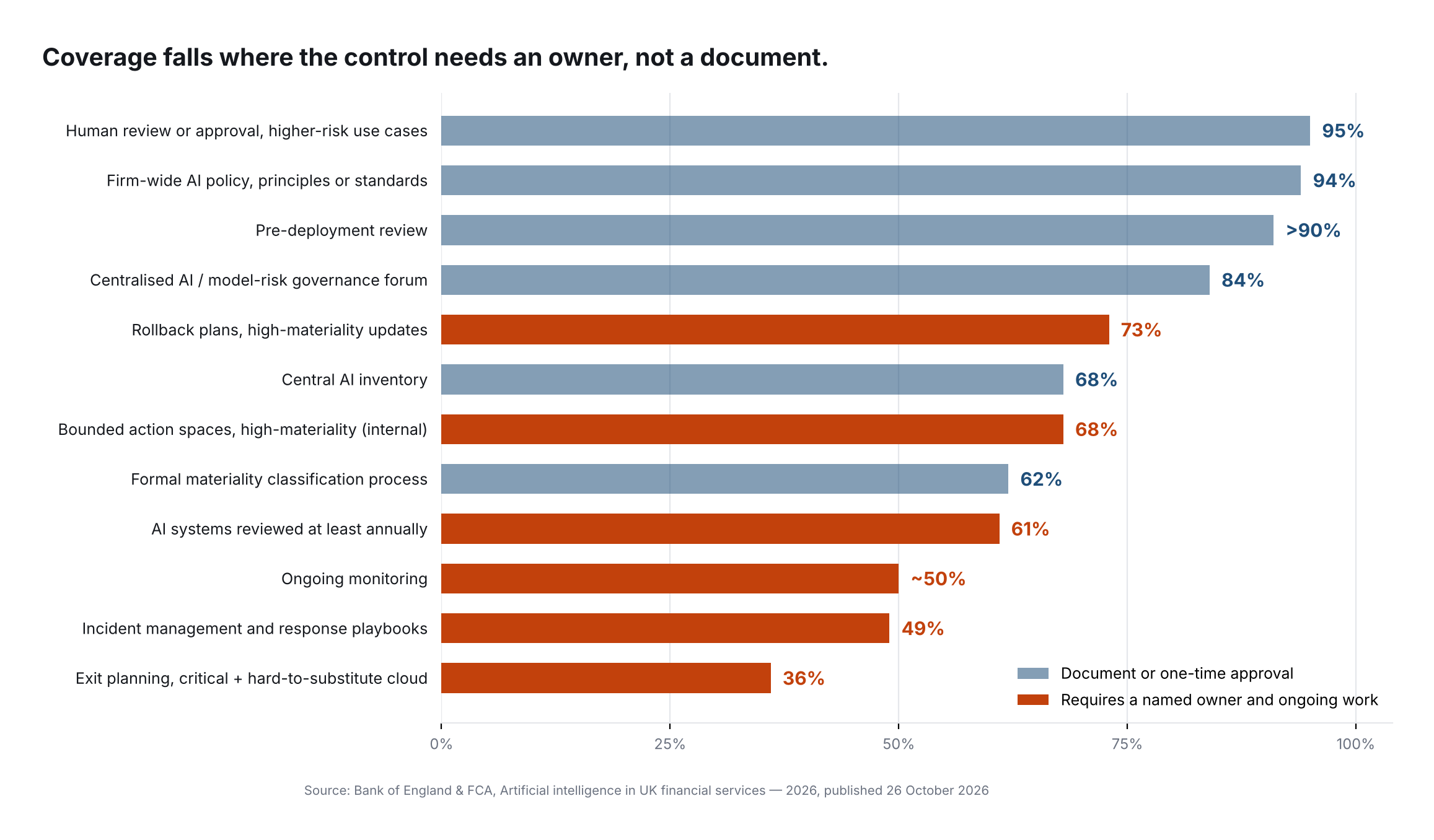
Human review or approval for higher-risk use cases: 95%. Pre-deployment review: over 90%. Firm-wide AI policies, principles or standards: 94%. A centralised AI or model-risk governance forum: 84%. Defined rollback plans for problematic high-materiality updates, always or usually: 73%. A central AI inventory: 68%. A formal materiality classification process: 62%. Reviewing AI systems at least annually: 61%. Incident management and response playbooks: 49%, the least common governance item in the survey. Exit planning in place for cloud and compute relationships that are both high criticality and hard to substitute: 36%.
The coverage declines in a specific order, and it is not random. It falls as the control stops being a document and starts requiring somebody to own a consequence.
A firm-wide AI policy costs a committee and a template. Ninety-four per cent have one. An incident playbook requires naming who gets woken up, what they are authorised to switch off, and what the firm tells customers while it is off. Forty-nine per cent have one. An exit plan for a hard-to-substitute critical provider requires admitting, in writing, that the firm has a dependency it cannot currently escape, and then funding the work to escape it. Thirty-six per cent have one.
Ongoing monitoring was reported by only around 50% of respondents. Sit that next to the 95% doing human review for higher-risk cases and the shape of the risk becomes clear. Firms are good at the control that happens once, at approval. They are materially weaker at the control that has to keep happening.
The floor moved while the bound held
Here is the finding that makes this survey worth 3,000 words rather than a post.
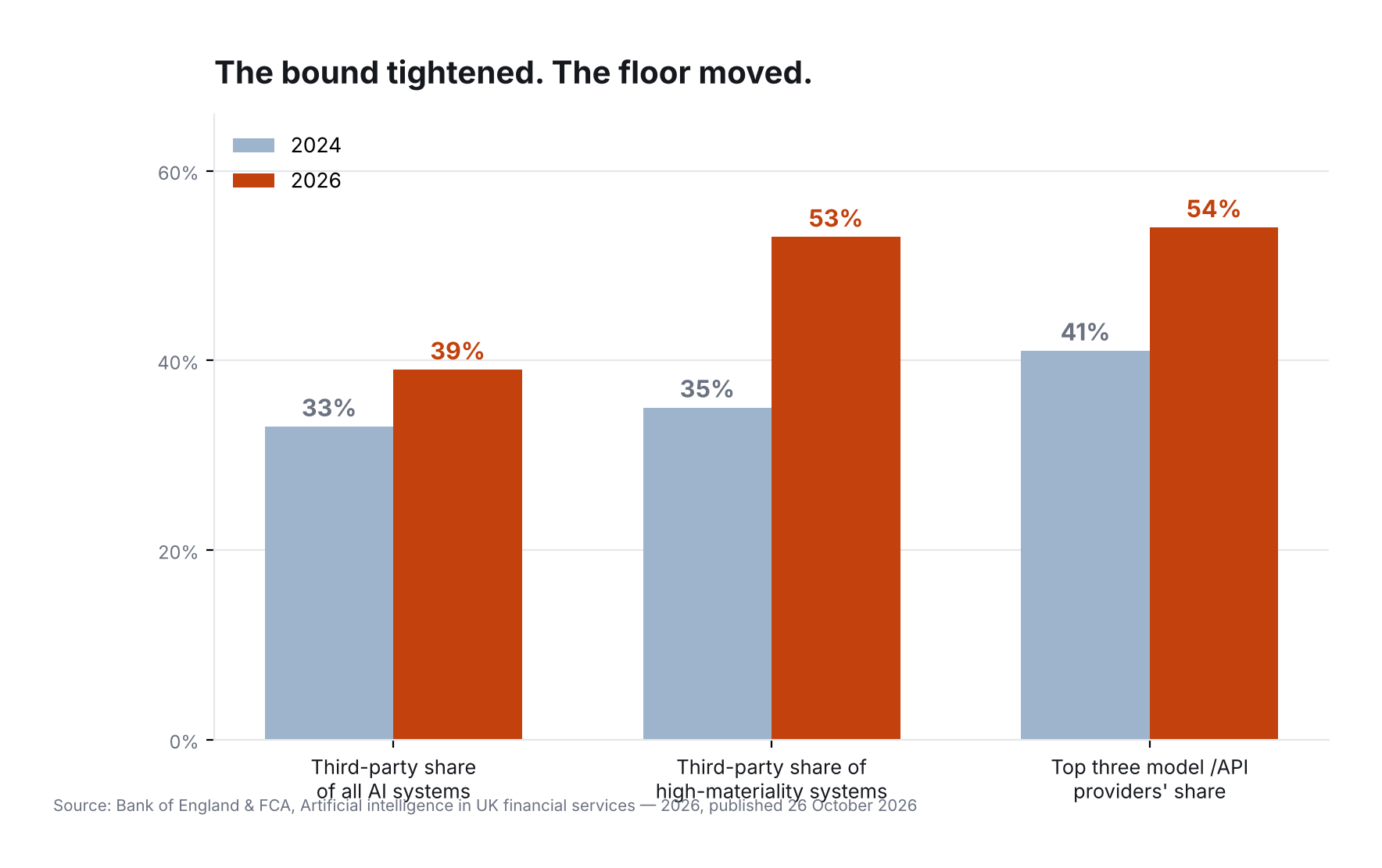
While firms were tightening what their agents are allowed to do, they were loosening what they own.
Third-party implementations accounted for 39% of all reported AI systems, up from 33% in 2024. That is a modest shift. The high-materiality figure is not. Third-party systems accounted for 53% of high-materiality AI systems, up from 35% in 2024.
In two years, the systems these firms themselves classify as most consequential went from roughly a third externally built to a clear majority.
The supplier side is more concentrated still. The three largest cloud and compute providers accounted for 79% of all reported relationships, and 98% of respondents used one of those three. The most-mentioned cloud provider's share rose from 36% to 40%. For model API and hosting, the three largest providers accounted for 54% of relationships, up from 41% in 2024.
And exit planning, for the relationships where it matters most, is mostly absent. For cloud and compute relationships rated both high criticality and hard to substitute, exit planning was absent for 47%, in progress for 18%, and in place for 36%. For model API and hosting relationships, 47% absent, 31% in progress, 22% in place.
So: the majority of high-materiality AI now runs on infrastructure the firm does not own, from a supplier set of three, and for nearly half of the relationships that are both critical and hard to replace, there is no plan for leaving.
There is a second concentration inside the firms themselves. Ten firms accounted for 62% of all reported high-materiality AI systems. The high-materiality population is not spread across the sector. It sits in a small number of large institutions, which is also where the supervisory attention will sit.
One more number deserves a sentence of its own. Twenty-five per cent of firms always or usually let high-materiality vendor updates propagate automatically into production. The report cautions that this rests on only 48 firms, so treat it as directional. But directionally it says a quarter of firms have a third party with write access to a high-materiality system and no gate in front of it. Forty-eight per cent always run regression testing on high-materiality vendor updates, with a further 25% usually doing so.
A bounded action space does not help you if the vendor can change what is inside the bound on a Tuesday without telling you.
What the survey does not say
Three limits, because a number without its denominator is how the last round of AI reporting went wrong.
This is self-reported data. Firms described their own controls, and nobody audited the answers. A firm that says it has a bounded action space is a firm that believes it has one. The 68% is a claim rate, not a verified rate, and the gap between those two is usually where the finding is.
The population is participating firms, not the UK financial sector. One hundred and ninety-six responded and only 105 completed the full survey, so most of the detailed percentages above rest on roughly a hundred firms. The regulators say so plainly. Several of the sharper figures rest on less: the automatic-propagation number comes from 48 firms, and the report flags it.
And the report is not internally perfect. The model-provider concentration figure appears as 54% in the text and 55% in Chart 9. It is a trivial discrepancy and I mention it only because this is a document people will quote for the next year, and the version you quote should be the one you opened.
None of that undermines the finding. It bounds it. The autonomy distribution is the kind of structural answer that self-reporting gets roughly right, because a firm does not usually misclassify whether its agent can execute a trade. The control-coverage numbers are the ones to treat as upper bounds.
The objection worth answering
The strongest argument against everything above is that the 2% is temporary and I am praising a snapshot.
It goes like this. Agentic AI is eighteen months old in production terms. Of course autonomy is low. Firms have not had time to build the confidence or the tooling, so the 2% reflects immaturity, not restraint, and it will drift upward regardless of what anyone decides. Reading a control into it is reading a control into a delay.
Part of that is right. Some of the 2% is certainly capability lag, and anyone treating this survey as proof of a settled industry norm is overreading it. The 14% planning agent deployment within twelve months tells you the population is still moving.
But the objection does not survive the detail. If the low autonomy were purely a lag, you would not see 68% and 64% of firms using bounded action spaces as a deliberate technique for understanding high-materiality systems. You would not see the categories themselves cleanly separated, with 46% at constrained execution and 22% at conditional autonomy — that is a distribution of firms that have thought about gradations of authority, not a distribution of firms that have not got there yet. And you would not see the four consequential actions capped at 9% while adoption sits at 86%. A firm that had simply not got around to autonomy would show a flat profile. These firms show a shaped one.
The honest version is that the 2% is part restraint and part lag, and the restraint is the part worth defending, because it is the part that will be under pressure next year when the tooling catches up and someone builds a business case for straight-through processing.
What the objection does get right is the direction of travel, which is exactly why the exit-planning gap matters now rather than later. Autonomy will rise. The dependency is already there. A firm that raises autonomy on top of a provider it cannot leave is compounding two exposures, and the second one has a two-year lead time to fix.
What this means under Australian prudential standards
For an Australian insurer or fund manager the survey is not foreign evidence. It is a readout on the same supplier set, measured against obligations that are already live here.
CPS 230, APRA's operational risk management standard, took effect on 1 July 2025. It requires a regulated entity to identify its material service providers, to set tolerance levels for disruption to critical operations, and to maintain exit plans for material arrangements. The BoE and FCA have just published a sector-level measurement showing that for the relationships that are both critical and hard to substitute, 47% have no exit plan at all. If the UK population looks like that, the Australian population very likely looks similar, because it is largely the same three cloud providers and the same handful of model providers.
The 53% figure is the one to carry into a CPS 230 conversation. If a majority of a firm's most consequential AI systems are third-party built, then AI governance and material service provider management are no longer two workstreams. They are the same workstream, and running them in different committees with different registers is how a firm ends up with a bounded agent sitting on an unbounded dependency.
CPS 234 is the other half. Where a third party holds or processes information assets, the entity remains responsible for information security control assurance. The survey's 25% figure on automatic propagation of high-materiality vendor updates is a CPS 234 problem described in different words: a change to a material information asset, made by someone else, with no assurance step in front of it.
ISO 42001 is worth naming because it is the standard that actually operationalises the distinction this survey measures. An AI management system under 42001 requires a defined scope of use, documented roles and authorities, and impact assessment before deployment. That is the autonomy ladder and the materiality classification, written as a management system rather than a survey response. Sixty-two per cent of surveyed firms have a formal materiality classification process, rising to 87% if you count partial and in-development arrangements. The gap between those two numbers is roughly where most firms' 42001 readiness sits.
What a CRO or COO should do on Monday
Pull the AI inventory and add one column: what can this system do without a human. Not what it is for. What it is permitted to execute. Sixty-eight per cent of surveyed firms have a central inventory and 92% have one at least partially, so the artefact probably exists in some form. The authority column usually does not.
Then sort by that column, not by model risk rating. The systems that can complete a consequential action alone are a different population from the systems with the highest model risk scores, and the first population is the one where an error becomes an event.
Take the four actions the survey singles out — approving or declining customer outcomes, executing trades, initiating payments, changing limits and controls — and confirm for each that no agent can do it. Then confirm it the way the 68% do, by checking the permission rather than reading the prompt. A control you verified by reading configuration is evidence. A control you verified by asking the build team is a conversation.
Next, take the systems the firm has classified high materiality and ask who built them. If more than half are third-party, which the sector-level figure suggests is now normal, then the register that governs them is the material service provider register, and it needs to be the same register the AI governance forum works from.
For every provider on that register that is both critical and hard to substitute, ask for the exit plan. Not the exit clause in the contract — the plan. What runs instead, how long the cutover takes, what degrades during it, who signs off on starting it. Thirty-six per cent of surveyed firms can answer that. If the answer is a contract clause, the firm is in the 47%.
Then look at vendor change control. Ask whether a high-materiality third-party system can take an update into production without a gate, and whether regression testing runs every time rather than usually. A quarter of surveyed firms answered that updates propagate automatically. That is a finding a board can act on in a single meeting, because the fix is a gate and a test, not a transformation programme.
Last, write the incident playbook, because 49% is the lowest number in the survey and it is the control that runs on the worst day. Name who can switch the system off. Name what the firm does manually while it is off, and for how long that is survivable. Name what customers are told. A firm that has bounded its agents beautifully and cannot answer those three questions has built a good control and no recovery.
The part that does not show up in a survey
The 2% will not hold by itself. It held this year because agentic deployment is young and because a lot of individually sensible engineers and risk officers drew the same line in the same place. Neither of those is a mechanism. Next year there will be a business case, a competitor claiming straight-through processing, and a vendor release note that quietly widens what the agent can reach.
The firms that keep the line will be the ones who wrote it down as an authority, assigned it to a named person, and made widening it require an approval that leaves a record. The firms that lose it will not decide to lose it. An integration will be added because it removes a manual step, and nobody will experience that as a governance decision.
Eighty per cent of these firms gave an AI agent a job. Two per cent gave it permission. The distance between those numbers is the best work the industry did this year, and none of it is load-bearing until somebody owns it.
The control you can describe is the one you bounded. The dependency you cannot exit is the one you did not.
Source: Bank of England and Financial Conduct Authority, Artificial intelligence in UK financial services — 2026, published 26 October 2026. All figures in this article and in its charts are taken from that report. APRA Prudential Standard CPS 230 Operational Risk Management took effect 1 July 2025.
Get these as they’re published.
Long-form on AI governance in regulated firms — what the control gap actually is, what regulators are asking for, and what the evidence has to look like. Roughly monthly. No pitches.