
9 September 2026
The four structural failures behind every AI governance program regulators are about to find
TL;DR: Regulators across four jurisdictions moved in one quarter. The institutions that filed policy documents are already behind. The ones that built runnable architecture are not. This article names the four structural failures separating the two groups, and what fixing them actually requires. * AI governance built around documents will not survive a regulatory exam that asks for raw evidence. * Assurance that runs quarterly on a system that changes daily is a dated snapshot, not a control.
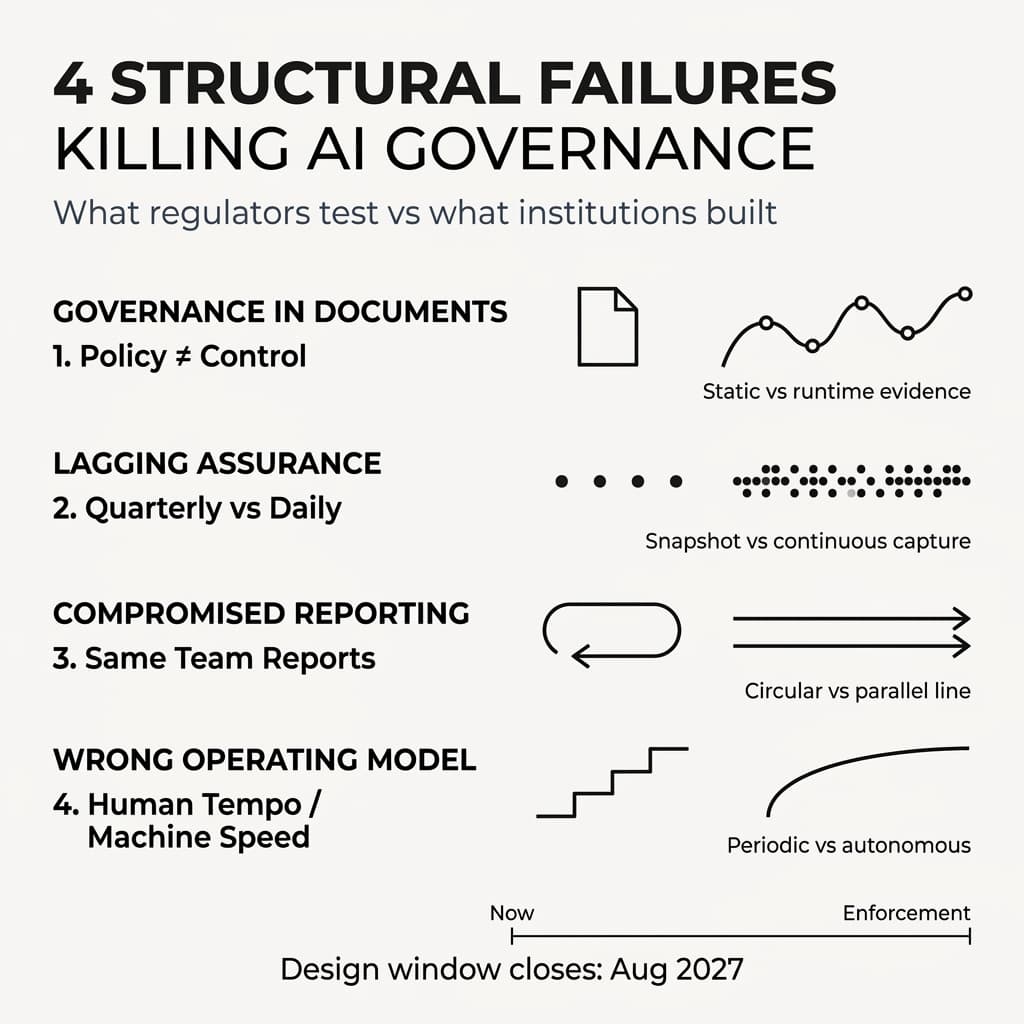
TL;DR: Regulators across four jurisdictions moved in one quarter. The institutions that filed policy documents are already behind. The ones that built runnable architecture are not. This article names the four structural failures separating the two groups, and what fixing them actually requires.
- AI governance built around documents will not survive a regulatory exam that asks for raw evidence.
- Assurance that runs quarterly on a system that changes daily is a dated snapshot, not a control.
- Board reports written by the program team are structurally compromised. Independent reporting lines are the fix.
- Operating models built for human decision-making cannot carry a system making autonomous decisions at machine speed.
- The design window closes around August 2027. Institutions that wait for prescriptive rules will be redesigning under a consent order.
In April 2026, APRA sent a letter to every bank, insurer, and superannuation trustee in Australia. It used the word "gaps" six times in three pages. It called out over-reliance on vendor presentations. It named assurance activity that was lagging deployment. It stopped short of prescription, but the intent was unambiguous.
Two months later the Financial Stability Board published 12 sound practices for AI governance in financial institutions. The FSB does not write binding rules. It writes the frameworks that become binding rules eighteen months later. IOSCO followed with a supervisory toolkit for AI in capital markets. The Fed, OCC, and FDIC moved in the same window. The ECB set October 31 as the deadline for banks to file their AI-cyber plans.
Four regulators. One quarter. Same message.
Boards read the coverage and asked their CRO to "get across AI." That request will produce a slide deck and a policy document. Neither will survive contact with what the regulators are actually looking for.
Regulators are looking for architecture. There is a difference, and the difference is where every enforcement action for the next three years will land.
The category error sitting underneath the whole response
Institutions are treating AI risk as another technology risk. That framing is why the governance response looks the way it looks.
Technology risk has a shape. There is a system. The system has an owner. The owner has controls. The controls are tested. The tests are reviewed. The review goes to a committee. The committee reports to the board. That model works because the system does one thing at one tempo, and a human is in the loop when it does something unusual.
AI does not have that shape.
A production model makes tens of thousands of decisions between committee meetings. Each decision has upstream dependencies on data, prompts, tools, memory, and prior state. The model can drift without any code change. The system's behavior can shift because a data source shifted, because a vendor updated a base model, or because a tool the agent calls returned something new. None of those inputs are inside the perimeter the old governance model was designed to protect.
Regulators have already worked this out. That is what "gaps" means in the APRA letter and what "novel and rapidly evolving" means in SR 26-2. The existing frameworks do not cover the system. Boards approving those frameworks as sufficient are approving the appearance of governance, not the substance of it.
Four structural failures show up inside institutions that made the category error. Each one is defensible individually. All four together are the exposure.
Key point: Treating AI as standard technology risk produces governance designed for the wrong system. The exposure is in the difference between what the framework covers and what the system actually does.
Failure one: governance that lives in a document
The most common AI governance artifact in a large financial institution right now is a policy. It has a title, an owner, an approval date, and a review cadence. It defines terms. It references frameworks. It names accountable executives.
Governance is what happens between the policy and the decision. It is the tempo at which controls run, the evidence they produce, the independence of the people reviewing that evidence, and the mechanism that stops the system when the evidence is insufficient.
A policy that says "high-risk AI decisions must be reviewed by a human" is not governance if the system makes 40,000 high-risk decisions per day. It is aspiration. The review capacity does not exist. Everyone in the institution knows the review capacity does not exist. The policy stays in place because writing it down was easier than solving for the actual tempo.
The regulator will ask two questions. Show me the last 100 automated decisions the system made. Show me the evidence trail behind each one, the human who reviewed it, and the escalation path that triggered when the review flagged concern. If the answer is a summary report and not the raw records, the institution has documented aspiration, not run controls.
Governance is a runnable system. If it does not run, it is a record.
Key point: A policy document is not a control. If the institution cannot show raw decision records and the evidence trail behind them, it has documented intent, not governance.
Failure two: assurance that lags deployment
APRA called this out explicitly. The letter noted that assurance is not keeping pace with the systems it is meant to assure.
The mechanism is familiar to anyone who has run a large program. The build team owns the timeline. The build team is measured on delivery. Assurance is a downstream function. Assurance activities are scheduled after the system is in production because scheduling them earlier would delay the go-live date, and delaying the go-live date is career-limiting.
This works when the risk of undetected drift is small. It does not work when the system is making decisions that will be reviewed by a court later.
The audit function inside institutions is set up to assure a system that stopped changing after go-live. AI systems do not stop changing. Model providers push updates. Data sources shift. Prompts evolve because the ops team tuned them last Thursday. Every one of those changes is a control event, and every one of those events should be evidenced at the time it happens.
Assurance that runs quarterly on a system that changes daily is not assurance. It is a snapshot with a compliance date attached.
The fix is architecture that produces evidence continuously, in a form that assurance can consume without recreating the record. Hash-chained decision logs. WORM evidence stores. Independent capture of prompts, tool calls, and outputs at the moment they happen. This is what "sound practice" will start to mean when regulators write the enforceable version of the current guidance.
Key point: Quarterly assurance on a daily-changing system is a dated snapshot. The fix is continuous evidence capture, built into the architecture, not scheduled after deployment.
Failure three: board reporting that compresses the signal
Boards see AI risk through the report they receive. The report is written by the team responsible for the AI program. The team responsible for the AI program is the team most exposed if the report says the program is red.
Internal reports track the actual health of the program. Board reports track the sanitized version. The delta between the two is tolerable in stable environments. It is legally actionable when the disclosure gap gets wide enough for a court to fit through.
ASX is now facing that exact scenario over CHESS. Federal Court penalty in July. Shareholder action to sue former directors filed this month. The internal RAG rating was red. The market was told the project was progressing well. That delta is now the litigation.
Every AI program running inside a systemically important institution has the same structure. The internal picture and the board picture do not match. In cases where the delta is already wide enough to be a problem, the people who could name it have no incentive to.
The fix is structural. Independent reporting into the board on the material AI programs. A parallel line, staffed by people who do not report to the accountable executive for the program, using primary evidence rather than program summaries. That is what independence means in the FSB framework. Institutions that do have it will find it in their audit function and be told the audit function is not resourced for this. That is the architecture problem to solve, not a reason to accept the existing reporting line.
Key point: A report written by the program team is structurally compromised. Independent board reporting, using primary records and a parallel staffing line, is the only structural fix.
Failure four: an operating model that cannot carry the system
This is the failure underneath the other three.
An operating model is who owns what, at what tempo, with what evidence, on what escalation path. It is not an org chart. It is not a policy. It is the runnable specification of how decisions get made and how the institution learns when they were made poorly.
AI systems demand an operating model that runs at the tempo of the system. If the model makes decisions in seconds, the control loop has to close in seconds for the decisions that matter. If drift can occur without a code change, the monitoring has to catch behavioral shift without waiting for a release. If a tool call to an external service changes what the agent does next, the record of that tool call has to be preserved with the same independence as a financial transaction.
Operating models in regulated institutions were designed for human decision-making with periodic system support. They cannot carry a system that makes autonomous decisions with periodic human oversight. The direction of the loop is inverted. Bolting AI onto the existing model produces a model that is neither: not the human-in-the-loop model the controls were designed for, and not the machine-speed model the system needs.
The redesign is what boards have not commissioned yet. It is expensive. It is disruptive. It moves accountability lines. It is also what regulators will require, in one form or another, over the next 18 to 36 months.
Institutions that start the redesign now will finish before the enforcement window closes. Institutions that wait for prescriptive rules will be redesigning under a consent order.
Key point: An operating model built for human decision-making cannot carry autonomous machine-speed systems. The redesign is what boards have not yet commissioned, and the enforcement window is the deadline.
What actually works
The architecture that survives regulatory contact has four properties.
- Governance runs at the tempo of the system it governs. Controls execute automatically, produce evidence automatically, and escalate automatically. The tempo of the human review matches the tempo of the decisions worth reviewing, and every decision worth reviewing is reviewed.
- Assurance is engineered into the system, not layered on afterward. Evidence is captured at the point of decision, in a form that cannot be reconstructed by the team that made the decision. Hash-chaining, independence properties, and plane separation logic are the substrate that makes the system defensible.
- Board reporting has a parallel line of independent evidence. The report the board receives from the program is not the only report the board receives about the program. The independent line uses primary records, not summaries, and reports on a cadence that matches the system's rate of change.
- The operating model is designed around the decisions the system makes. Ownership is named. Tempo is defined. Escalation paths run automatically. Handover from build to run is documented and evidenced.
This is buildable today. It requires design work most institutions have not started. It cannot be bought as a product. It has to be architected against the specific decisions the specific institution is automating.
Key point: Runnable architecture, continuous evidence capture, independent board reporting, and a tempo-matched operating model are the four properties that survive a regulatory exam. All four have to coexist.
The window
Two dates matter.
October 31 is the ECB deadline for bank AI-cyber plans. The plans filed by that date will be the reference point for supervisory conversations for the next 18 months. Plans that describe policy and intent will be reopened. Plans that describe runnable architecture will be tested against the reality of the systems in production.
August 2027 is roughly when the FSB sound practices are likely to convert into prescriptive expectations in the major jurisdictions. That is the enforcement window opening. It is 12 months away.
The window between now and then is the design window. Every automated decision made under a governance structure designed for humans is a decision the institution will have to defend later. The volume of those decisions grows every day the redesign is not underway.
Directors reading the FSB report and asking their CRO for a summary will receive a summary. Directors who ask to see the last 100 automated decisions their institution made, and the evidence trail behind each one, will receive the actual answer.
The actual answer is the real governance posture. Everything else is a record of intent.
Key point: October 31 and August 2027 are the two dates that define the design window. The time between them is not a wait-and-see period. It is the only period in which the redesign can happen without regulatory pressure attached.
Frequently asked questions
What did the APRA letter actually say about AI governance?
The April 2026 APRA letter, sent to all Australian banks, insurers, and superannuation trustees, used the word "gaps" six times in three pages. It named over-reliance on vendor presentations and identified assurance activity lagging deployment as specific concerns. It stopped short of issuing prescriptive rules, but the directional intent was clear.
What is the difference between an AI governance policy and AI governance architecture?
A policy names accountable executives, defines terms, and references frameworks. Architecture is the runnable system that executes controls, produces evidence, and escalates automatically. A policy describes what should happen. Architecture is what actually runs between decisions.
What does hash-chaining mean in the context of AI governance?
Hash-chaining is a method of linking each decision record to the previous one using a cryptographic hash, so that any tampering with the record is detectable. In AI governance, it is used alongside WORM (write once, read many) evidence stores to produce a decision log that cannot be reconstructed after the fact by the team that made the decisions.
Why is quarterly assurance insufficient for AI systems?
AI systems change continuously. Model providers push updates. Data sources shift. Prompts are tuned by ops teams between audit cycles. Quarterly assurance captures a snapshot of a system that no longer matches the snapshot by the time the report is written. The control event and the evidence of it have to occur at the same time.
What did the ASX CHESS case establish for AI governance risk?
The ASX CHESS case showed that when the internal risk rating is red and the board or market is told the program is progressing well, the disclosure gap becomes the litigation. The Federal Court penalty landed in July. Shareholder action against former directors followed. The same structural exposure exists in AI programs where internal and board-level pictures do not match.
What does the FSB framework mean by independence in board reporting?
Independence in the FSB framework means a reporting line staffed by people who do not report to the accountable executive for the program, using primary evidence rather than program summaries. A second copy of the same report from the same team is not independent reporting.
When does the enforcement window for AI governance open?
August 2027 is the approximate point at which FSB sound practices are expected to convert into prescriptive expectations in major jurisdictions. The ECB deadline of October 31 for AI-cyber plans is the earlier reference point. Institutions filing plans before that date will have their plans tested against the actual systems in production over the following 18 months.
Can existing governance frameworks be updated to cover AI, or does the operating model need a full redesign?
The operating models in regulated institutions were built for human decision-making with periodic system support. Bolting AI onto that model inverts the control loop direction and produces a model that functions as neither. The redesign has to be commissioned against the specific decisions the institution is automating, at the tempo those decisions actually run.
Key takeaways
- Four regulators moved in one quarter in 2026. The consistent message is that governance architecture, not policy documentation, is what supervisors will test.
- A policy is a record of intent. Governance is a runnable system that executes controls, produces evidence, and escalates automatically at the tempo of the AI system it governs.
- Assurance has to be engineered into the system at the point of decision. Quarterly reviews of a continuously changing system are not controls.
- Board reporting written by the program team is structurally compromised. Independent parallel reporting lines, using primary records, are the structural fix the FSB framework names.
- Operating models designed for human decision-making cannot carry autonomous machine-speed systems without inverting the control loop. That redesign has not been commissioned in the institutions that need it most.
- The design window is October 2026 to August 2027. Institutions that wait for prescriptive rules will be redesigning under a consent order.
- The actual governance posture is visible in the raw evidence behind the last 100 automated decisions. Everything else is a record of intent.
Get these as they’re published.
Long-form on AI governance in regulated firms — what the control gap actually is, what regulators are asking for, and what the evidence has to look like. Roughly monthly. No pitches.