
28 October 2026
The FSB published nine AI deployments. The best numbers had the thinnest controls.
The Financial Stability Board spent most of this year asking supervisors and firms what responsible AI adoption actually looks like. On 15 October 2026 it published the answer, and it did something unusual for a standard-setter. It showed its working. Buried in Sound Practices for Responsible Adoption of Artificial Intelligence (AI): Final report are nine real deployments from real financial institutions. Banks, insurers, an asset manager, a payment network. Each one has a use case. Most have a
The Financial Stability Board spent most of this year asking supervisors and firms what responsible AI adoption actually looks like. On 15 October 2026 it published the answer, and it did something unusual for a standard-setter. It showed its working.
Buried in Sound Practices for Responsible Adoption of Artificial Intelligence (AI): Final report are nine real deployments from real financial institutions. Banks, insurers, an asset manager, a payment network. Each one has a use case. Most have a number.
Read them side by side and a pattern falls out that the report never names.
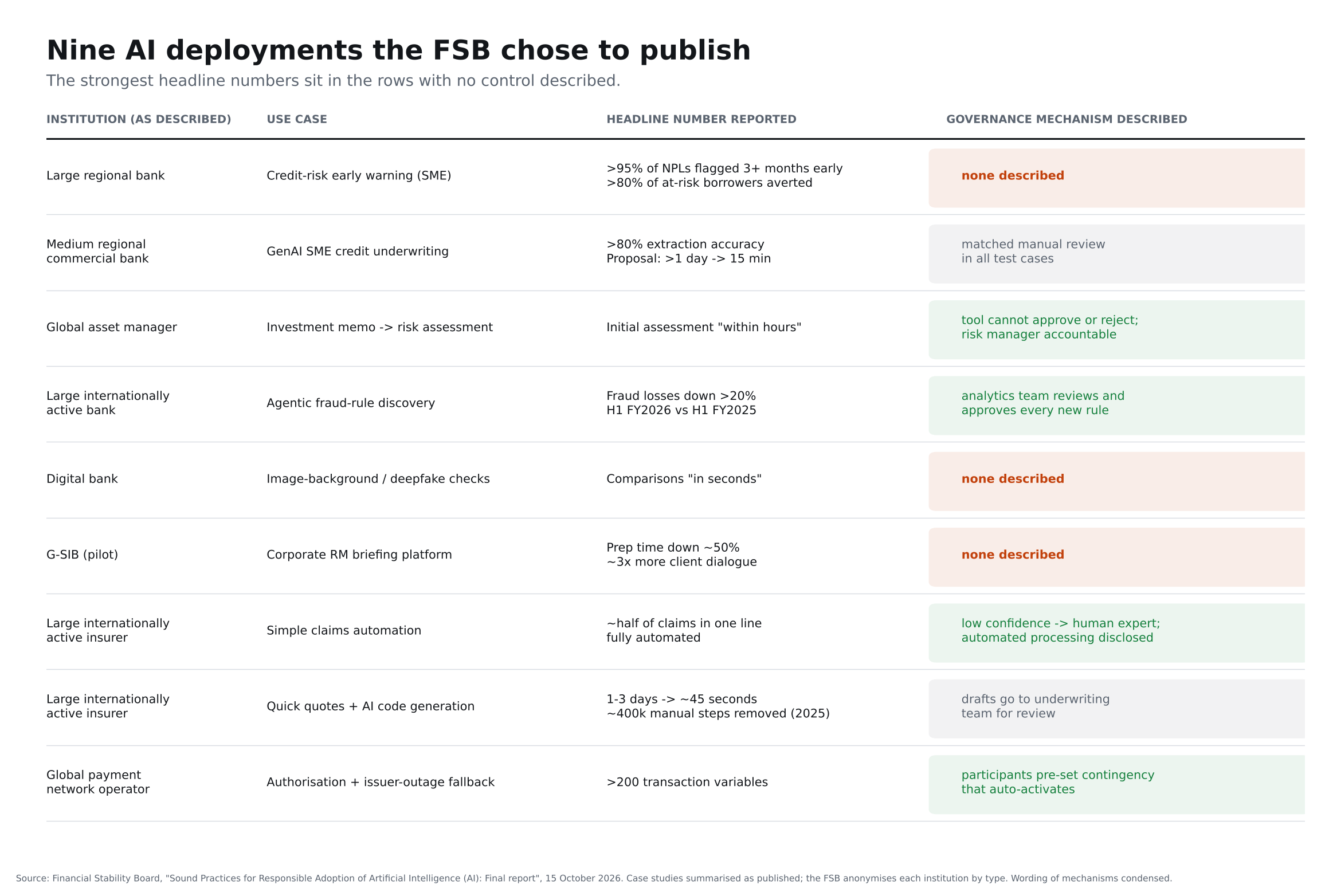
The deployments with the most impressive headline numbers are the ones with no governance mechanism described. The deployments that describe their controls in detail report the most modest results.
That is not a coincidence, and it is not an argument against governance. It is the clearest picture anyone has published this year of how firms talk about their own AI.
What the FSB actually published
The report is the final version of work the FSB has been running since its 2024 monitoring exercise. It sets out twelve numbered Sound Practices, covering board oversight, accountability, materiality assessment, model selection, data governance, explainability, performance management, human oversight and third-party dependency.
It is not binding. No FSB report is. It is the document national supervisors will reach for when they write the thing that is binding, which is why it matters more than its status suggests.
The nine case studies sit in boxes through the first half of the report. The FSB anonymises each institution by type rather than by name. You get "large internationally active bank" and "global asset manager", not a masthead. That is a real limitation and I will come back to it.
Here is what each one claims.
A large regional bank runs machine learning to flag SME borrowers whose cash flow is deteriorating. In 2022 it identified over 95% of non-performing SME loans at least three months early, and averted default for over 80% of at-risk borrowers. No control is described.
A medium-sized regional commercial bank uses generative AI for SME credit underwriting. Over 80% accuracy on financial data extraction. Preliminary proposal time down from more than a day to fifteen minutes. The report notes the system matched manual review for flagging data inconsistencies and potential fraud across all test cases.
A global asset manager turns investment memoranda into initial risk assessments for private-markets proposals. Assessments arrive within hours. Outputs link back to mandate rules and source documents. The tool does not approve or reject anything, and the risk manager remains accountable.
A large internationally active bank built an agentic system that identifies emerging fraud patterns and proposes detection rules. It monitors more than 80 million signals a day. It was built in three months. It helped develop or update three quarters of the bank's card fraud rules. Fraud losses fell by over 20% in the first half of FY2026 against the same period in 2025. The fraud analytics team reviews and approves every new rule before implementation.
A digital bank checks image backgrounds to catch mule accounts, fake identities and injection attacks. Comparisons finish in seconds. No control is described.
A G-SIB piloted a platform that assembles external news, research and internal knowledge into client proposals. Preparation time fell by roughly half. Relationship managers reported around three times more client dialogue. No control is described.
A large internationally active insurer automated simple claims. Roughly half the claims in one business line now process fully automatically, and simple claims are paid within hours of filing. Claims where the model's confidence is insufficient route to a human expert. The insurer updated its privacy notices to explain when processing may be fully automated, and customers can reach a human.
A second large internationally active insurer automated underwriting quick quotes and put AI into software development. About 400,000 manual processing steps eliminated in 2025. Around 4,000 quote requests a month. Turnaround down from one to three business days to about 45 seconds. Six million lines of code generated, with around 80% adoption among developers. The system drafts assessments and the underwriting team reviews them.
A global payment network operator uses AI in authorisation decisions and in managing issuer outages. It evaluates more than 200 transaction variables. Participating institutions pre-set contingency parameters that activate automatically when defined disruption conditions are met.
The objection, answered before it is raised
The honest reading first.
These are self-reported case studies, filtered through supervisors, anonymised, and almost certainly submitted by firms that wanted to look good. Absence of a described control is not absence of a control. The large regional bank with the 95% figure may well have a credit officer sitting on every one of those alerts. The FSB simply did not print it.
So the pattern is about disclosure, not necessarily about practice.
Take that seriously, and then notice that it does not rescue the position. These firms chose what to put in the box. They had a few hundred words and a supervisor's attention. The ones that led with a control were telling you what they were proud of. The ones that led with 95% were telling you the same thing.
What a firm volunteers about its own AI is evidence about that firm. Not conclusive evidence. Evidence.
There is a second objection worth taking on. You could argue the relationship runs the other way for a dull reason: tightly controlled systems are deployed on narrow problems, and narrow problems produce smaller numbers. A human approving every output caps your throughput, so of course the controlled cases look less dramatic.
That is partly true and it is the most interesting thing in the report, because one case breaks it.
The one that did both
The agentic fraud system is the case to study.
It has the hardest outcome number in the set. Not a time saving, not an adoption rate, not a percentage of documents parsed. Fraud losses down more than 20%, half-year against the same half-year. That is a profit-and-loss number with a comparable baseline and a stated period. It is the only figure in the nine that a CFO would recognise as a result.
It also has the tightest control in the set. The fraud analytics team reviews and approves every new rule before implementation.
Hold those two facts together, because the design decision underneath them is the whole argument.
The agent does not act on transactions. It proposes rules. A human approves the rule. The approved rule then acts on millions of transactions.
That is the move. The human sits at the point of maximum leverage and minimum volume. One analyst reviewing one rule governs everything that rule will ever touch. You get machine scale on the execution and human judgment on the authority, and you do not have to trade one for the other.
Compare it with the shape most firms build. An alert goes to a human. Each alert needs a decision. Volume rises, the queue grows, the humans start rubber-stamping, and within a quarter you have automation bias wearing a control's uniform. The FSB names this directly: human oversight "may be weakened by over-reliance and/or automation bias" (p. 16).
Putting the human on the rule rather than the alert is not more governance. It is less governance, placed better.
The line most people will skim past
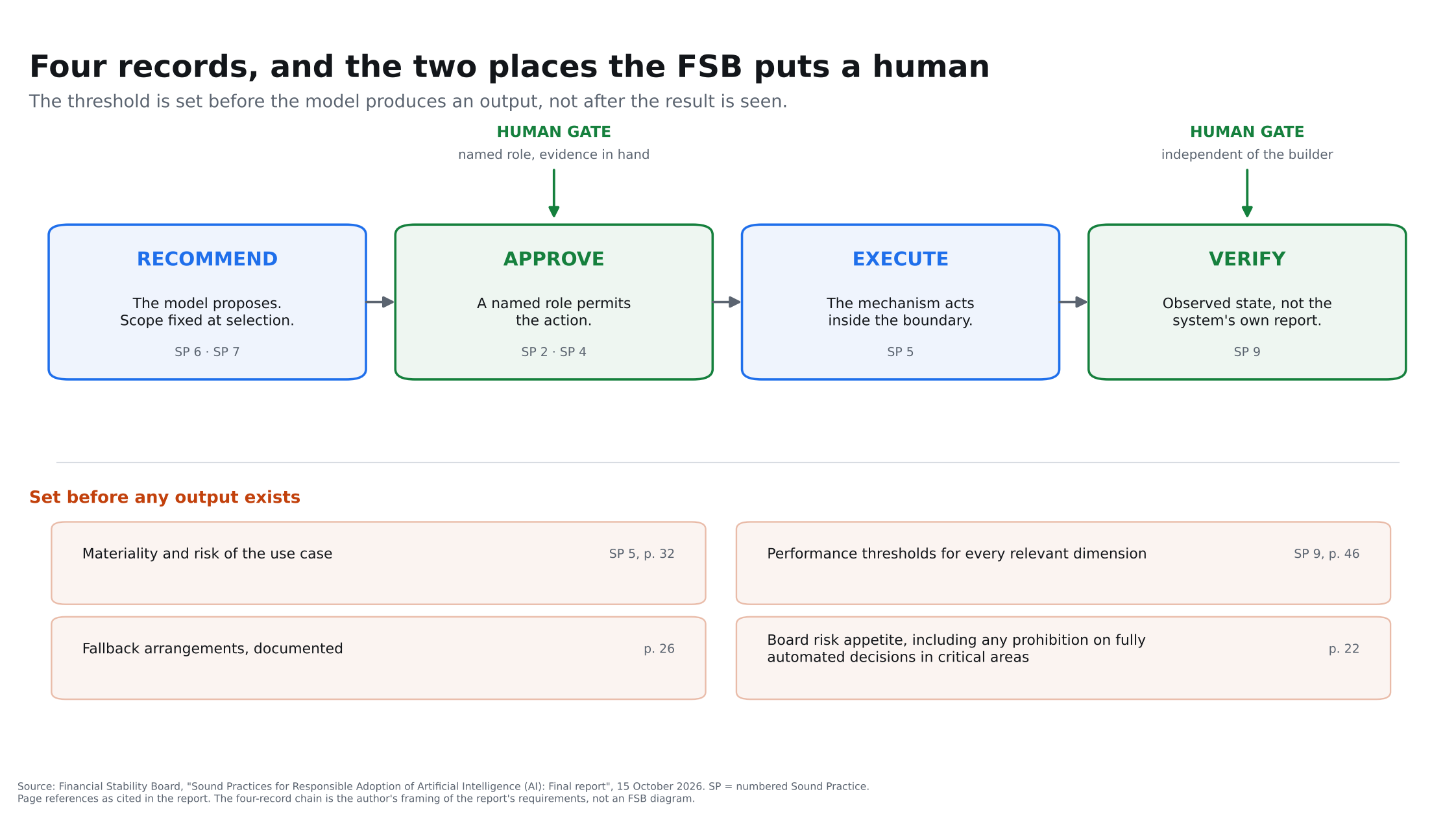
On page 46, inside Sound Practice 9, the report says firms should specify thresholds for all relevant dimensions of AI performance, and that where possible those thresholds should be set before outputs are generated.
Before outputs are generated.
That is the most operationally demanding sentence in the document and it will get less attention than anything about agentic AI.
Firms that get this wrong get it wrong the same way. The model is built. The results come back. Someone looks at the results and writes the acceptance criteria to fit them. The threshold is reverse-engineered from the outcome, then written into a paper that goes to a committee, and everybody involved can say with a straight face that the model met its criteria.
It did. The criteria were chosen afterwards.
A threshold set after you have seen the output is not a control. It is a description. The FSB is drawing the line where it has to be drawn, and the test is trivially auditable: find the date on the threshold document and the date on the first model output, and see which is earlier.
That is a question a board member can ask without any technical knowledge at all. Most firms will not enjoy answering it.
The same logic runs through the rest of the report. Materiality and risk assessed at the use case (SP 5, p. 32). Fallback arrangements documented as a dependency (p. 26). Staff keeping the skills to operate when AI is unavailable or degraded (p. 28). Where AI monitors another AI model, the monitoring system must be independent of the model under review (p. 23). Boards setting AI risk boundaries as part of risk appetite, including prohibitions on fully automated decisions in critical areas (p. 22).
None of it is exotic. All of it has a date you can check.
Two more controls worth stealing
Two of the nine describe mechanisms that are easy to lift and almost nobody runs.
The global asset manager's is one sentence: the tool does not approve or reject investments, and the risk manager remains accountable. Its outputs link back to mandate rules and source documents.
Read that as a design constraint rather than a disclaimer and it does real work. The system is barred from producing the artefact that would look like a decision. Not discouraged from it. Barred. There is no field in which it can record an approval, so there is nothing for a reviewer to mistake for one later.
For a fund manager this maps onto the investment committee with no translation. An AI that drafts an initial risk assessment for a private-markets proposal is useful. An AI whose output arrives in the committee pack formatted like a recommendation, with the risk manager's name at the top because the template put it there, has quietly acquired a vote. Nobody granted it one. The template did.
Link the output to the mandate rule it was tested against and the source document it came from, and the committee can see the boundary of what the assessment covers. Leave those links off and you have a confident paragraph with no evidence boundary, which is the most dangerous object in any investment process.
The payment network's control is the other one. Participating institutions pre-set contingency parameters that activate automatically when defined disruption conditions are met.
The important word is pre-set. The fallback is agreed while everyone is calm, by people who are not currently losing money, and it fires on a condition rather than on a judgment call at three in the morning. The FSB lists fallback arrangements among the dependencies a firm should document (p. 26), and asks that staff keep the skills to operate when AI is unavailable or degraded (p. 28).
That is the same requirement CPS 230 makes of critical operations, arriving from a different direction. If your AI-assisted process has no documented state it drops into when the model is unavailable, you have not deployed a tool. You have added a single point of failure to a critical operation and called it an efficiency.
The test is simple enough to run this week. Turn the model off in a non-production environment and see whether the process still has a defined path. If the answer is that the team would "work it out", that is not a fallback. That is an outage with optimism attached.
The disclosure number nobody wants
Nine days before the FSB report, Evident published the fifth edition of its AI Index for Banks. It ranks 50 of the world's largest banks across North America, Europe and Asia-Pacific on more than 70 indicators, using only public information. Talent carries 45% of the weight, innovation 30%, leadership 15%, and transparency of responsible AI activities 10%.
JPMorganChase came first overall and first on the transparency pillar. CommBank second on transparency, RBC third. UBS placed sixth overall, the only European bank in the top ten. HSBC fell from eighth to eleventh.
Two findings from that index matter here more than the league table.
Forty-nine of the fifty banks now publish responsible AI principles. In 2023, sixteen did. More than two thirds report detailed controls for their AI systems. AI governance headcount across the fifty grew 33% in a year.
Twelve of the fifty disclosed a return on an AI investment. Last year it was eight.
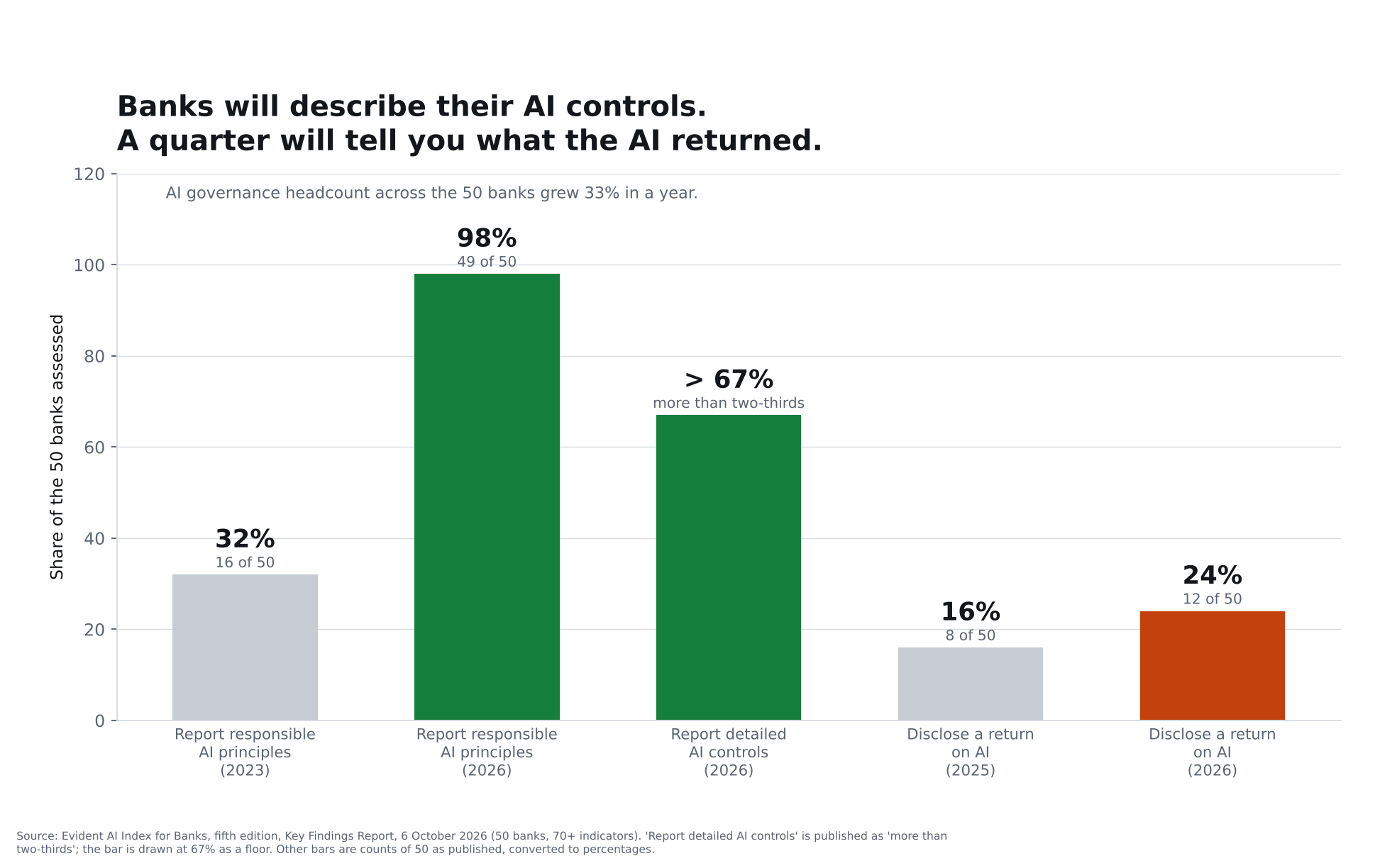
Those fifty banks have published more than 1,100 AI use cases since 2021. Twenty-four per cent of them will tell you what any of it returned.
Lloyds is one that will. It put roughly £50 million of value on its generative AI work for last year and said in January it expects over £100 million in 2026. Lloyds ranks fifteenth on the index overall. It is not the most advanced bank in the table. It is one of the twelve that can answer the question.
Why those are the same finding
The FSB pattern and the Evident number are one fact seen twice.
A firm that can produce a defensible outcome number has already done the governance work, whether or not it calls it that. To say fraud losses fell 20% half-on-half, you need a baseline that predates the deployment, a defined period, a comparable prior period, and a view on what else changed. That is a measurement system someone designed before the model went live.
A firm that cannot produce the number does not have that system. It has a deployment and a feeling.
And a firm without a baseline cannot do the one thing the FSB asks for repeatedly: evaluate performance proportionately to materiality and risk, against thresholds, over time. Not because it lacks a policy. Because there is nothing to measure against.
Which is why the counting matters more than the counting sounds. Forty-nine banks have principles. Twelve have a denominator.
Principles are cheap and the index shows they have become near-universal in three years. The baseline is the expensive part, and it is the part that turns into evidence when a supervisor asks.
What this means under CPS 230, SS1/23 and ISO 42001
For an Australian bank or insurer, none of this is new law. CPS 230 has been in force since 1 July 2025. It requires you to identify your critical operations, understand the processes and resources supporting them, and manage material service providers. A model that proposes fraud rules, prices a quote in 45 seconds, or decides which claims pay without a human sits inside a critical operation or it does not. If it does, the FSB's four records are the evidence CPS 230 already expects you to be able to produce.
The third-party sentence in the FSB report is the one to paste into your next vendor paper: financial institutions remain accountable for AI outcomes, even when they rely on third-party tools and services (p. 18). CPS 230 says the same thing in different words, and so does CPS 234 about the security of information assets a third party manages. The AI layer has not created a new accountability question. It has made the existing one harder to avoid.
In the UK, the PRA's SS1/23 already runs model risk management on five principles, including identification, governance and independent validation. A firm with a mature model risk function does not need a new framework for AI. It needs to stop letting AI tools enter production through a route that bypasses the one it has.
ISO 42001 is useful here for a narrow reason. It gives you a management-system shape for the AI estate, which is what most firms are missing. It will not tell you where to put the human. The FSB report will.
The objection a COO will actually make
"We are not automating decisions. It is a copilot. A person is always in the loop."
I would push on three things.
First, where is the loop? If the human sees the output after the system has acted, that is review, not approval. Those are different controls with different failure modes, and firms routinely document one while operating the other.
Second, who owns the integration? The quiet way authority moves is an engineer connecting a recommendation feed to an execution path because it removes a manual step. Nobody signs anything, because it did not look like an approval question. It looked like plumbing. If connecting two systems can change who decides, that connection needs the same approval as the decision it changes.
Third, what happens at volume? A control that works at fifty cases a day may not survive five thousand. The FSB's automation-bias warning is not about bad people. It is about queue length. Ask what the review rate was in month one and what it is now, and if nobody measures the review rate, you do not have the control you think you have.
What to do on Monday
Pick one AI use case. Not the estate, not a framework. One.
Find the threshold document and the first model output, and compare the dates. If the threshold came second, you have found the gap and you have found it cheaply. Fix that one before you buy a tool.
Then write down four things for that use case, on one page: what the system recommended, who approved the action, what executed, and what independent evidence confirms the resulting state. Most firms can fill in the first and the third. The second is usually a name nobody has written down. The fourth is usually the system's own completion message, which is a claim, not a verification.
Then ask where the human sits. On the alert, or on the rule. If it is on the alert, work out what the rule-level equivalent would be, because that is where your judgment buys the most and costs the least.
Then find your denominator. What was the baseline, when was it struck, and what else changed in the period. If you cannot answer that for your flagship use case, you are not in a position to tell your board what AI has returned, and you will not be in a position to tell a supervisor either.
None of that requires a budget line or a new committee. It requires somebody to go and look.
The part that will age badly
Nine firms sent the FSB a description of their AI. Three of them led with a number and said nothing about who was allowed to act on it.
In two years those three will not be remembered as the ambitious ones. The standard is being written right now, and it is being written by the ones who could say both.
Fraud losses down over 20%. Every rule approved by a named team before it went live.
Either of those sentences alone is a press release. Together they are a control environment, and only one firm in nine wrote both.
Get these as they’re published.
Long-form on AI governance in regulated firms — what the control gap actually is, what regulators are asking for, and what the evidence has to look like. Roughly monthly. No pitches.