
9 June 2026
The model layer is done — what you build around it is everything
I need to be direct about something. Most organizations haven't processed this yet. The race to pick the right AI model is over. The capital needed to unseat any big player is astronomical. Yet XAI built GPT-5-class capability in under 12 months. DeepSeek achieved similar results in weeks with a fraction of the budget. Within 30 days, every major Chinese lab matched it. The moat is not the model. It never was. All the benchmarks show minute differences. Give Claude and GPT the same prompt,
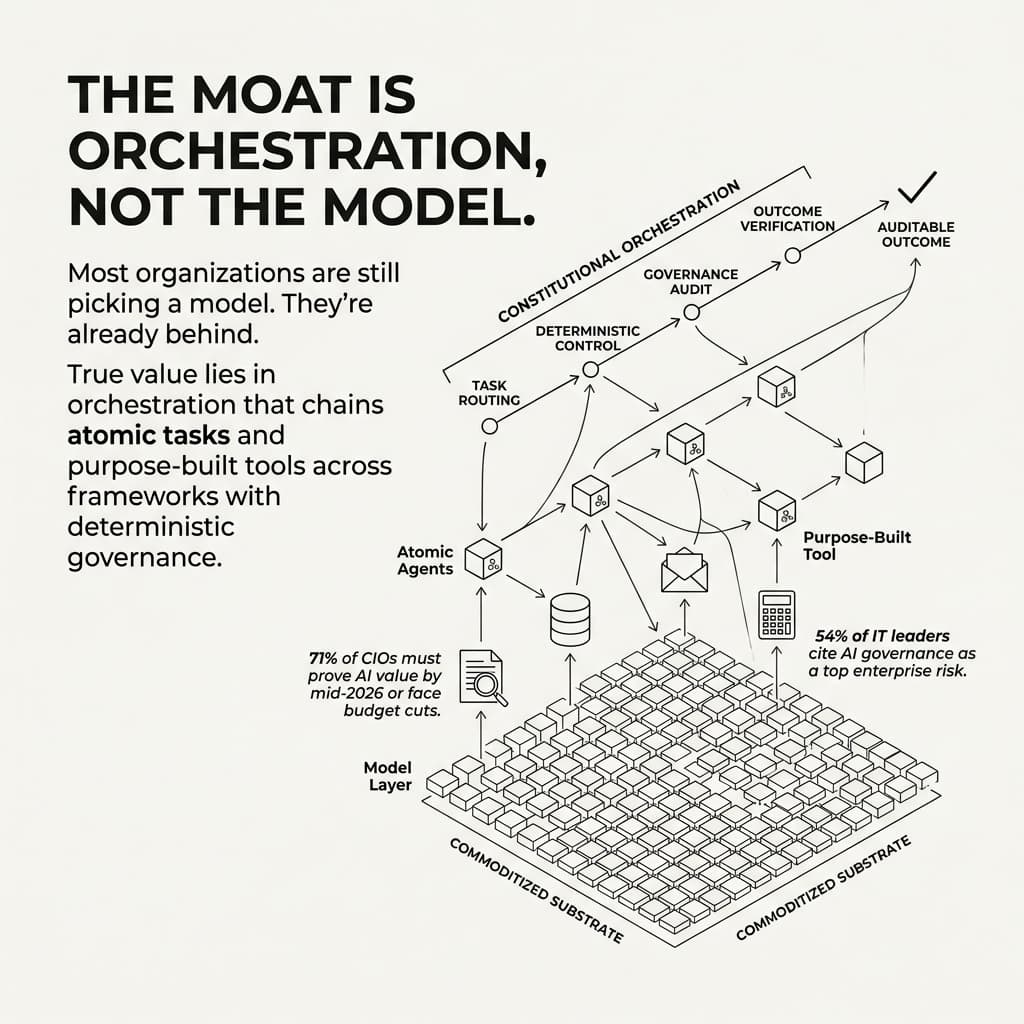
I need to be direct about something.
Most organizations haven't processed this yet.
The race to pick the right AI model is over.
The capital needed to unseat any big player is astronomical. Yet XAI built GPT-5-class capability in under 12 months. DeepSeek achieved similar results in weeks with a fraction of the budget. Within 30 days, every major Chinese lab matched it.
The moat is not the model. It never was.
All the benchmarks show minute differences. Give Claude and GPT the same prompt, you get a very similar outcome. Foundation models converge to similar representations as performance increases, despite differences in architecture, training data, or training objective.
The model layer is commoditized.
The cloud parallel is precise. With cloud, infrastructure became utility. The explosion came from microservices: small, specialized, composable.
With AI, it's agents at the atomic level, choosing the right model for the job.
The real differentiator is AI combined with the right tools.
What atomic actually means in practice
Atomic means designed from first principles. Broken down to a task that can be completed within half the context window of a session.
Each tool chained through a lifecycle to produce an outcome.
This is operational design, not metaphor.
Most organizations still think about AI as a monolithic capability. They want one model to do everything. They want it smart enough to figure out what it needs.
That approach worked when models were scarce and expensive. It doesn't work now.
80% of Fortune 500 companies run active AI agents built with low-code and no-code tools. Most lack unified governance, deterministic process control, and measurable outcomes.
71% of CIOs must prove AI's value by mid-2026 or face budget cuts.
You need agents that do one thing well. You need tools purpose-built for specific tasks. You need orchestration that chains those tools together in a sequence that produces the outcome you need.
The model is the substrate. The tools are the differentiator.
Why non-determinism changes everything about governance
AI won't give you deterministic output the way microservices did.
It's like thousands of little employees doing little tasks using different tools. Each one making micro-decisions about which tool to use, how to interpret the input, what to prioritize.
This is where most organizations are going to fail.
They'll build agents. They'll chain tools together. They'll get results that look good in demos.
Then they'll try to scale. The system will produce outputs that can't be explained, can't be audited, and can't be defended to regulators.
Governance has to cover whether agents are choosing the right tool and what they're being influenced or informed to use.
You need a deterministic or synthesized better outcome inside a controlled environment.
This is engineered substrate, not compliance theater.
Governance is the infrastructure that makes responsible AI adoption possible and defensible to leadership, legal teams, and regulators.
For regulated industries like financial services, healthcare, and government, the stakes get higher. 54% of IT leaders cite AI governance as a top enterprise risk priority, up from 29% two years earlier.
The orchestration problem no one is solving correctly
Real enterprises run LangChain, CrewAI, Agentforce, Microsoft Copilot, and homegrown agents simultaneously.
Production-grade orchestration must coordinate agents across frameworks. Not lock you into one.
This is the single biggest gap in most orchestration tools.
You need orchestration that can:
Route tasks to the right agent based on capability, not availability. Most systems send work to whatever agent is free. You need systems that understand what each agent is good at and route accordingly.
Chain atomic tasks through a lifecycle that produces an auditable outcome. Log each step. Make each decision traceable. Make each output verifiable.
Handle failure gracefully without cascading across the system. When one agent fails, the system should reroute, retry, or escalate. Don't take down everything downstream.
Measure cost per outcome, not cost per token. In 2026, the central question will no longer be "Can we do this with AI?" but "Can we afford to do this at scale?"
AI that cannot justify its operational cost will be turned off, regardless of how impressive the demo looks.
This is a design problem, not a product problem.
Best practices for building atomic agent systems
Here's what works in production environments where failure has consequences.
1. Design tools for single, verifiable outcomes.
Each tool should do one thing. It should do that thing completely. It should produce an output that can be verified programmatically.
If your tool is called "analyze_document" and it also sends emails, you've failed. Split it into "extract_document_metadata" and "send_notification." Chain them in orchestration.
2. Keep task scope within half the context window.
If your agent needs the full context window to complete a task, the task is too large. Break it down.
Atomic tasks should consume no more than 50% of available context. This gives you room for error handling, retry logic, and state management.
3. Build orchestration as constitutional logic, not workflow automation.
Workflow tools chain steps. Constitutional orchestration defines what agents can and cannot do, what tools they can access, what data they can see, and what outcomes they're allowed to produce.
This is the difference between a process diagram and an operating system.
4. Instrument every decision point for auditability.
You need to know which agent made which decision, which tool it chose, what data informed that choice, and what the output was. This is not optional in regulated environments. This is table stakes.
Log every input, every tool invocation, every output, and every error. Build hash-chaining and WORM evidence structures if you're in financial services or healthcare.
Make the audit trail tamper-evident.
5. Treat model selection as a runtime decision, not a deployment decision.
Your agents should choose the right model for the task. GPT-4 for reasoning, Claude for long-context analysis, a fine-tuned model for domain-specific tasks.
The orchestration layer should route to the model that optimizes for cost, latency, and accuracy based on task requirements.
This is where commoditization becomes an advantage. You're no longer locked into one vendor. You're optimizing across all of them.
6. Measure outcomes, not activity.
Most AI systems measure tokens consumed, API calls made, agents deployed. These are activity metrics. They tell you nothing about whether the system is producing value.
Measure outcomes. Did the agent complete the task? Was the output correct? Did it do so within cost and latency constraints?
Would a human have done it faster or better?
If you can't answer those questions, you don't have a production system. You have a science experiment.
7. Build for cost efficiency from day one.
Per-unit AI costs are deflating, but total spend is inflating. Usage scales faster than efficiency gains. You need systems designed to minimize waste.
Cache common queries. Batch requests where latency allows. Use smaller models for simple tasks. Route to the cheapest provider that meets quality thresholds.
Shut off agents that aren't producing measurable value.
8. Design for cross-framework coordination.
You will not standardize on one agent framework. You will have LangChain agents, CrewAI agents, vendor-specific agents, and homegrown agents.
Your orchestration layer must coordinate across all of them.
This means building abstraction layers that normalize inputs and outputs. Not trying to force everything into one framework.
What happens when you get this right
Organizations that build atomic agent systems with purpose-built tools and constitutional orchestration will move faster than their competitors.
They'll scale AI without scaling risk. They'll audit their systems without grinding to a halt.
They'll prove value to leadership and regulators without theater.
The model layer is commoditized. The tools you build, the orchestration you design, and the governance you engineer are the only things that matter now.
Most organizations are still trying to pick the right model. They're already behind.
Get these as they’re published.
Long-form on AI governance in regulated firms — what the control gap actually is, what regulators are asking for, and what the evidence has to look like. Roughly monthly. No pitches.