
12 October 2026
The Safe Way to Use AI in High-Stakes Work
TL;DR: The Superior Court of Québec ran AI with 22 judges for 98 days and kept every decision with the judge. It worked because the court narrowed the job first, then verified every output, evaluated the use, and kept the deployment reversible. * Limit AI to preparatory and support tasks. Leave judgment with a human. * Require the reviewer to verify every output. * Evaluate the work around the model, not only the adoption figures. * Name the stop conditions before launch. A safe AI deploym
TL;DR: The Superior Court of Québec ran AI with 22 judges for 98 days and kept every decision with the judge. It worked because the court narrowed the job first, then verified every output, evaluated the use, and kept the deployment reversible.
- Limit AI to preparatory and support tasks. Leave judgment with a human.
- Require the reviewer to verify every output.
- Evaluate the work around the model, not only the adoption figures.
- Name the stop conditions before launch.
A safe AI deployment begins by narrowing the job.
The clearest evidence is the Superior Court of Québec's evaluation of its 98-day artificial intelligence pilot, published in April 2026.
What did the Québec court actually test?
The pilot ran from December 8, 2025, to March 16, 2026. It involved 22 volunteer judges (11.17% of the bench) and nine specialized AI agents. The court limited the agents to preparatory and support tasks, required judges to verify every output, and kept the deployment inside a secure institutional environment.
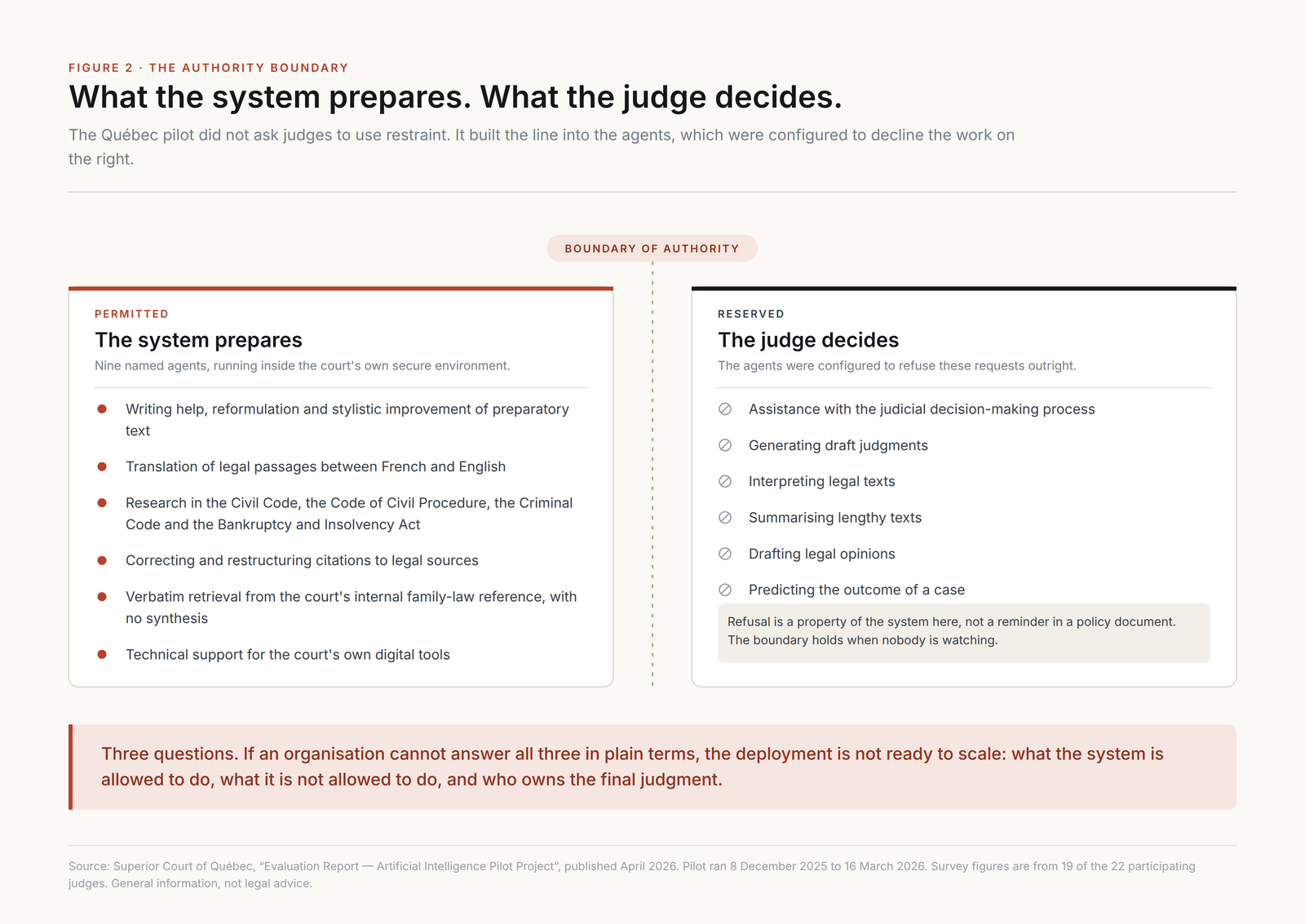
The system itself enforced the boundary. The agents were configured to refuse the excluded work: decision-making assistance, draft judgments, interpreting legal texts, summarizing lengthy texts, legal opinions, and predicting outcomes.
The design also included continuous evaluation and reversibility. The court could assess the use, change the conditions, or stop the experiment.
The pilot produced 479 writing-assistant sessions, with 94% engagement. The final survey drew 19 of the 22 judges. Of those, 84% said AI was compatible with judicial work if a clear governance framework existed, and 89% said they would be comfortable continuing to use it within a well-defined framework.
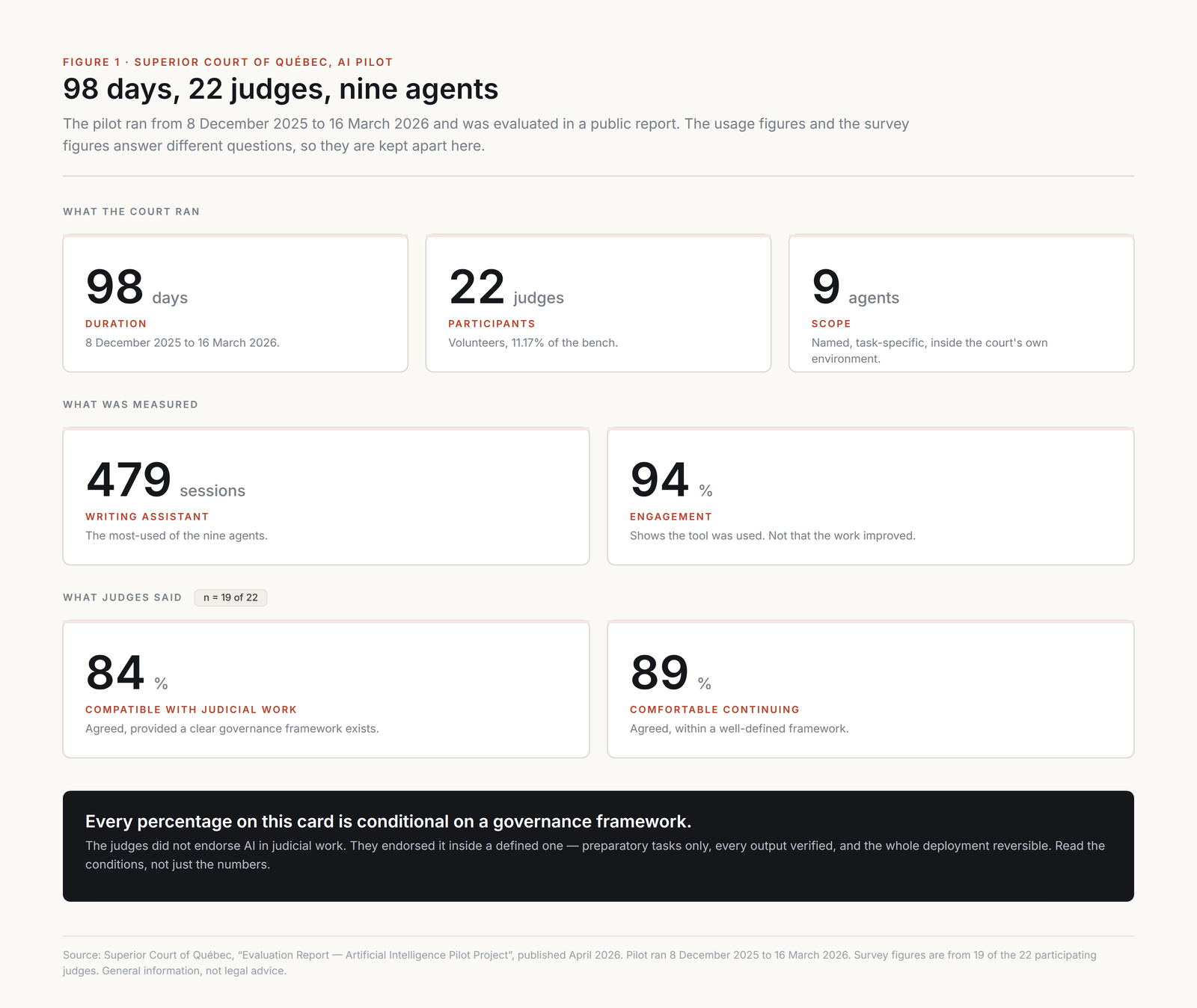
Those numbers matter, and the operating design behind them matters more.
Key point: The results rest on a narrow task, a boundary the system enforced, verified output, ongoing evaluation, and the ability to stop.
Why define the boundary before measuring the benefit?
Organizations often start an AI deployment with a broad outcome like productivity, efficiency, or automation.
That creates a measurement problem before the system is in use. If the task is unclear, the organization can't tell whether the system improved the work, changed the risk, or moved responsibility somewhere less visible.
The Québec court started with a narrower question: what work could an AI system support without taking over the judgment that belonged to a judge?
That question creates a usable boundary.
The system assists with defined preparation. The judge stays responsible for the decision. Every output gets checked, and the institution can review and reverse the deployment at any point.
This is a better starting point for high-stakes work because it makes authority visible.
Key point: Define the task first. The court could measure the system because it knew exactly what the system was allowed to do.
How do you separate assistance from judgment?
A useful AI deployment doesn't need to remove human judgment to create value.
In regulated environments, the more important design decision is often the line between recommendation and authority.
An AI system can organize information, find relevant material, produce a first draft, or flag a possible inconsistency. Those functions reduce friction without handing the consequential decision to the system.
The boundary has to be explicit, because a system that prepares material runs under a different control model from one that determines an outcome. In Québec, the agents were configured to refuse excluded tasks, alongside training, verification and judges’ professional obligations.
That distinction applies across financial services.
An AI assistant might prepare a claims file for review, classify documents in an investment operation, or flag transactions that deserve investigation. Each use still needs a clear statement of what the system can do, what it can't do, and who owns the final judgment.
If the organization can't answer those three questions, the deployment isn't ready for scale.
Key point: The system prepares material and the human owns the decision. A deployment that can't state that split in plain terms isn't ready for scale.
How do you build verification into the work?
The Québec pilot required judges to verify every output.
That requirement beats a general instruction to use AI responsibly, because it ties the control to the action.
Verification needs an object. The reviewer has to know what to check, what evidence to use, and what to do when the output can't be supported.
A practical verification design should establish:
- the source material the system was allowed to use
- the parts of the output that require human review
- the standard for accepting or correcting the output
- the record kept when a material change is made
- the escalation path when the reviewer cannot resolve an issue
This is operational work. A policy statement doesn't create verification on its own.
The reviewer also needs enough time and authority to challenge the result. If a team is measured only on throughput, a control that demands careful review will be treated as an obstacle.
Therefore the operating model has to make the safe behavior possible.
Key point: Verification works when it names the source material, the review standard, the record, and the escalation path. A policy statement alone doesn't do that.
What should an AI evaluation measure?
The court reported 479 writing-assistant sessions and 94% engagement. Those figures show the system was used. They don't prove it improved judgment or reduced risk.
The survey has its own limit: 19 of the 22 judges responded. So an AI evaluation needs more than adoption or approval figures.
A useful evaluation should examine at least four dimensions:
- Whether the system performed the permitted task.
- Whether the output met the required quality standard.
- Whether the human reviewer could detect and correct errors.
- Whether the workflow remained accountable when the system was wrong.
The last one is easy to miss. A system can look accurate while making the surrounding process harder to understand.
The evaluation should therefore cover the work around the model: whether people knew when to challenge the output, whether they could explain the decision afterward, and whether the system created new approval steps or hidden dependencies.
The court's approach gives regulated organizations a usable method: measure the technology inside the work, where it actually runs.
Key point: Adoption numbers show use. Quality and accountability take the four dimensions above.
Why keep the deployment reversible?
Reversibility changes the quality of a decision.
When a deployment is treated as permanent, teams defend the original choice. Problems become exceptions to manage instead of evidence that the design needs to change.
A reversible deployment works differently. The organization can test a defined use, watch the result, and stop when the conditions are no longer acceptable.
That requires a practical stop condition.
The organization should know which signals trigger review, restriction, or withdrawal. Those signals might include recurring errors, a change in the underlying data, an inability to verify outputs, or evidence that responsibility has become unclear.
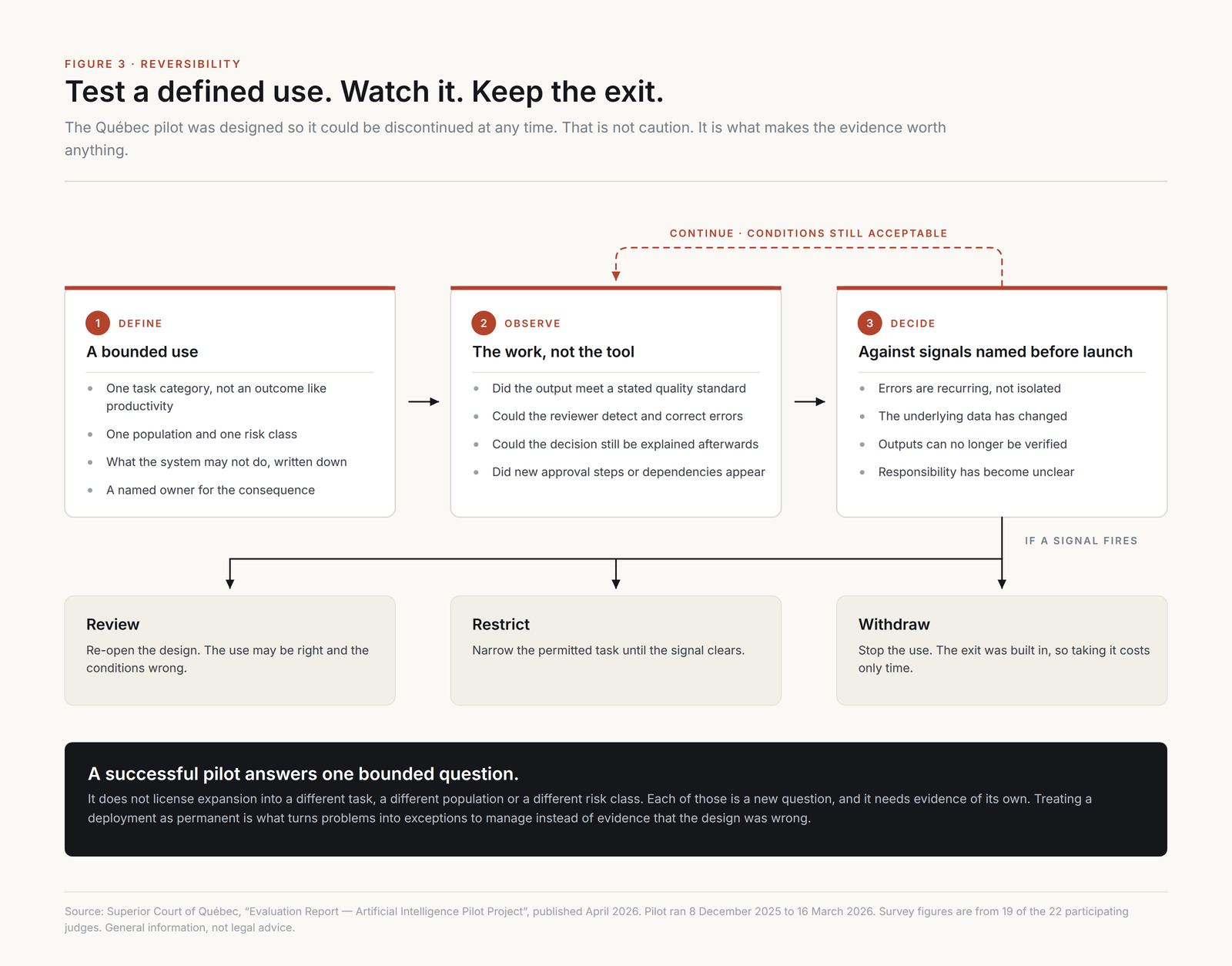
Reversibility also keeps the institution from mistaking early use for proof of readiness.
A successful pilot answers a bounded question. It doesn't automatically justify expansion into a different task, population, or risk class.
Key point: Name the stop signals before launch. A pilot answers one bounded question, so expansion needs its own evidence.
What should you design before the automation?
The court's pilot gives a rule for every regulated AI program:
Design the boundary of authority before designing the scale of automation.
That means deciding:
- what the system is allowed to do
- what remains outside its authority
- who is accountable for the consequence
- how the output will be checked
- which evidence supports continued use
- when the organization will stop or reverse the deployment
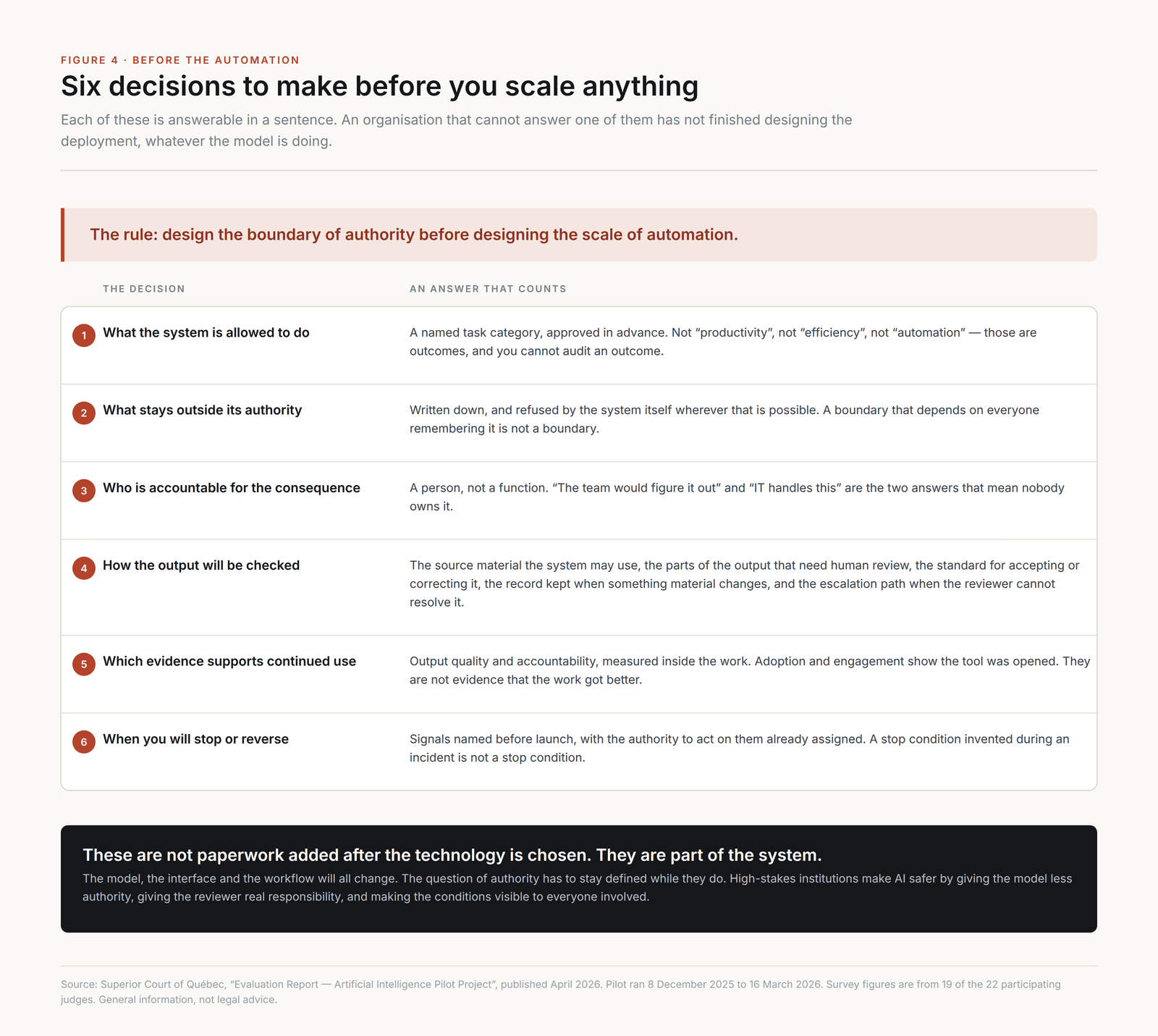
These decisions aren't paperwork added after the technology is selected. They're part of the system.
The model, the interface, and the workflow can all change.
The question of authority has to stay defined while they do.
High-stakes institutions make AI safer by giving the model less authority, giving the reviewer real responsibility, and making the conditions visible to everyone involved.
The Superior Court of Québec showed that AI can support consequential work when the institution defines the boundary first, verifies what crosses it, and keeps the decision under accountable human control.
Key point: Authority gets designed first. Model, interface, and workflow change around it.
Frequently asked questions
What did the Superior Court of Québec test?
A 98-day AI pilot, run from December 8, 2025, to March 16, 2026, with 22 volunteer judges (11.17% of the bench) and nine specialized AI agents. The court published its evaluation in April 2026.
What were the AI systems allowed to do?
Preparatory and support tasks only. The agents were configured to refuse decision-making assistance, draft judgments, interpreting legal texts, summarizing lengthy texts, legal opinions, and predicting outcomes. Judges verified every output, and the deployment ran inside a secure institutional environment.
What did the final survey show?
19 of the 22 judges responded. Of those, 84% said AI was compatible with judicial work if a clear governance framework existed, and 89% said they would be comfortable continuing to use it within a well-defined framework.
Does 94% engagement show the AI improved judicial work?
No. Together with the 479 writing-assistant sessions, it shows the system was used. It doesn't prove the system improved judgment or reduced risk.
Why does reversibility matter in a pilot?
Teams defend decisions treated as permanent. A reversible deployment lets the organization test a defined use and stop when conditions are no longer acceptable.
What should a verification design include?
The source material the system may use, the parts of the output that need human review, the standard for accepting or correcting output, the record of material changes, and the escalation path.
Does the pilot mean AI should run judicial work?
No. The court limited the systems to support tasks and kept the decision with the judge.
Key takeaways
- Narrow the job first. The Québec court limited AI to preparatory and support tasks and configured the agents to refuse everything else.
- Keep the decision with an accountable human, and state what the system can't do.
- Tie verification to the action: named sources, a review standard, a record, and an escalation path.
- Measure quality and accountability, not only adoption.
- Set stop conditions before launch. A successful pilot answers one bounded question.
- Design authority before scale.
Sources
- Evaluation report: AI pilot project, Superior Court of Québec (April 2026)
- Artificial intelligence governance framework, Superior Court of Québec (September 2025)
Get these as they’re published.
Long-form on AI governance in regulated firms — what the control gap actually is, what regulators are asking for, and what the evidence has to look like. Roughly monthly. No pitches.